


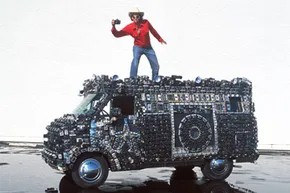
Defining “art car” is harder than it sounds. Is a truck an art car? What about a motorcycle? Does it need to be beautiful? These questions yield as many answers as asking “What is art?” The common thread isn’t aesthetics. It’s expression. The vehicle becomes a canvas for the creator’s identity.
Most experts agree on a few baseline rules. First, there must be genuine craft. Slapping handprints on a hood doesn’t cut it. Harrod Blank, author of Art Cars, noted that covering a Volkswagen Beetle in stained glass required more skill and decision-making than building a giant duck. Second, the vehicle must drive. If it’s stationary, it’s sculpture. Art cars are usually driven daily or used as secondary vehicles. They aren’t tucked away in garages. They are meant to be seen.
Types of Art Cars
Categories are loose guidelines. Boundaries blur constantly. But most fall into these buckets:
- Paint Cars: Words or patterns applied directly to the surface.
- Glue Cars: Objects attached from fender to fender.
- Message Cars: Vehicles carrying a specific statement, from self-promotion to world peace.
- Sculpted Cars: Beyond glue. Towering shapes built onto the body.
- Interactive Cars: Designed for public play. Buttons, writing surfaces, and physical engagement.
The movement started in the late 1970s and early 1980s. Artists didn’t know others were doing the same thing. The first Houston Art Car Parade happened in 1988. It is now the largest gathering of its kind. By the mid-1990s, art cars were appearing at Burning Man in Nevada. Over the last decade, festivals have popped up across the US.
Why turn a working car into a shark? Or cover it in cameras? Or build a Gothic cathedral on a hearse? These cars exist. Many more do.
Who Creates Art Cars?
The demographic spread is wide. Men, women, young, old, rich, poor. Kelly Lyles created “Excessories ODD-yssey,” covered in shoes, purses, and jewelry. Hyler Bracey spent over half a million dollars on “Big Horn,” featuring the world’s largest horn. Uri Geller built a car covered in bent silverware.
Some artists take commissions. Lyles painted peacocks and herons on a Toyota Prius for a client. Most make their work for themselves. The process is deeply personal.
The result guarantees attention. Drivers attract crowds. Some seek this out. Others are surprised by the smiles and waves. Blank observed that people are eccentric. They wear their quirks on their sleeves. Some drivers shy away from the spotlight.
Many creators coordinate costumes. Lyles wore leopard print for “Leopard Bernstein.” Blank wears a suit covered in flash bulbs for “Camera Van.” Functionality takes a backseat to the look. Blank can’t even sit down in his suit.
Maintenance is a frequent question. How do you wash it? The answer: carefully. A garden hose. Never a car wash. Lyles washes her cars once a year. Blank says washing is unpleasant. Some parts cannot get wet.
Let’s look at the mechanics of building these beasts. And the history of BMW Art Cars.
The BMW Art Car Legacy
BMW started the modern tradition in 1975. They asked artist Alexander Calder to paint a BMW 3.0 CSL for Le Mans. The project spawned 17 unique cars. Famous artists have contributed.
Andy Warhol painted an M1 with bright paint swaths in 1979. Robert Rauschenberg used black and white graphics on a 635C SI. Robin Rhode created the latest entry in 2009. He painted a BMW Z4 convertible. The tires spun out paint onto a massive white canvas. The dynamic result was used in print and TV ads.
You want to build a rolling gallery. Good luck.
Most beginners start with a beater. A mistake. You spend hundreds of hours gluing, painting, and sculpting only to watch the transmission fail. Cheri Brugman learned this the hard way. Her car, “Pestilencia,” was a flame-thrower-equipped beast. When the mechanical issues mounted, the cost to repair outweighed the art. She had to crush it.
Don’t make her mistake. Start with a reliable foundation. A solid engine and drivetrain are non-negotiable. You’re not building a sculpture for a museum shelf. You’re building a machine that has to drive.
Surface Prep and Material Science
The surface matters more than you think.
Years of wax, sealant, and road grime create a barrier. Adhesives need bare metal or plastic to bond. If you skip this step, your art peels off after the first rainstorm.
Newer cars are the enemy of the glue gun. Their clear coats are too smooth. Lyles, a seasoned art car fabricator, noted that the Prius commission was a nightmare because of that high-sparkle finish. You have to scuff it down. You have to dull the shine.
Older cars? They’re scuffed already. They’re ready.
When it comes to attachment, silicone glue is your best friend. It holds. It flexes. It survives vibration. For heavier items, use pop rivets. Glue alone will fail under stress.
Avoid house paint. It bubbles. It cracks. It fades in a single season. Use paint designed for road signs. It withstands UV radiation and weather. Apply a clear coat on top for extra protection.
Paper is out. It turns to tatters in the rain. Enamel paint is out. It fades in the sun. Stick to materials that respect the environment.
The Timeline of Obsession
How long does it take?
A few weeks for a simple paint job. A year for a fully integrated, sculptural piece. Some cars, like “glue cars,” are never truly finished. You’re always adding. Always adjusting.
With a dolphin on wheels, the finish line is obvious. With a collage of mixed media, it’s a moving target. You keep working until you’re sick of it. Or until the wheels fall off.
Practicality vs. Artistry
These are daily drivers.
You still need to see. Forward and rear visibility must be maintained. Mirrors help, but if your art blocks the windshield, you’re not driving. You’re posing.
You still need to maintain the engine. Oil changes. Check-ups. If you seal the hood shut, you’re locked out of your own mechanical needs.
Safety codes apply. Public roads demand compliance. If your art violates visibility or structural integrity laws, you’ll get a ticket. Or worse, an impound.
The Hidden Costs of Art Cars
People touch them.
Not always kindly.
Bits and pieces fly off. If you didn’t secure your materials properly, you’re leaving a trail of debris on the highway. That’s a safety hazard. That’s a lawsuit.
Gas mileage drops.
Weight increases. Aerodynamics suffer. A typical art car isn’t built for efficiency. “Camera Van” weighs 7,000 pounds. That’s not a car. That’s a mobile apartment.
If fuel prices spike, these cars become liabilities. Blank points out that rising gas costs will limit how far we can drive these beasts. You might not be able to take them on long road trips anymore.
Case Study: The Glass Quilt
Ron Dolce’s “Glass Quilt” is a masterclass in patience.
He worked on a VW Beetle for 18 years. Eighteen years.
Each piece of glass was scored and broken by hand. He fitted them to the car’s curves. No gaps. No rough edges. The result is a smooth, continuous surface. It’s precise. It’s time-consuming. It’s highly crafted.
Dolce says, “If you want to really see it, you must touch it.”
He’s right. The details are too fine for a quick glance. You have to get close. You have to run your hand over the glass to feel the precision.
Where to Find Them
Art cars don’t just appear. They gather.
Parades. Festivals. Museum exhibits.
These are the places where the ephemeral meets the permanent. Where the temporary becomes part of history.
Look for them. They’re waiting.
The Rise of the Art Car Movement
There was a long stretch of time where enthusiasts had nowhere to go. The 1980s arrived without the internet. No Facebook groups. No Twitter feeds to connect people who loved modified vehicles. Just silence.
Then came 1988.
Houston held its first parade in Texas. Ten or fifteen cars showed up. It was small. Modest. Fast forward twenty years and that modest event became the largest art car show in the US. We are talking about 250 to 300 vehicles now. Every variation of the concept is represented there.
San Francisco wasn’t far behind. The ArtCar Fest started in 1997. It is now the second-largest show in the country. Meanwhile, the Burning Man Project in Nevada’s Black Rock Desert began incorporating modified vehicles in the mid-90s. They created a Department of Mutant Vehicles to vet the entries. The bar for “artiness” was set by organizers.
Museums and Permanent Collections
You don’t just see these cars at festivals anymore. They are in museums.
The ArtCar Museum in Houston has an exterior made of scrap metal and chrome. David Best, a car artist, built it. The American Visionary Art Museum focuses on self-taught artists. Their “You Can Build an Art Car” exhibit offers guidelines for those who want to try.
Harrod Blank is building his own museum: Art Car World. He already has 42 vehicles in the collection. Two stand out.
The “Mondrian Mobile” is based on Piet Mondrian’s colorblock paintings. The “Carthedral” is a towering black Gaudi-style cathedral built on a hearse.
Mainstream institutions noticed too. The Petersen Auto Museum in Los Angeles held an exhibition in 2003. It featured “Glass Quilt” by Ron Dolce and “Make My Movie!” by Dennis Woodruff. Woodruff’s car was a drivable billboard for himself. Given the location, it fits. It is in the permanent collection.
The Economic Reality
Shows are popping up everywhere. This helps local artists. It hurts the big national events.
Why? Gas prices.
Putting a giant shark body on a car lowers fuel economy. Most of these base vehicles don’t get great gas mileage to begin with. Traveling to a show costs money.
Some festivals reimburse artists for fuel. Those funds are dwindling. It is getting more expensive to participate.
Why Now?
Why did this movement start when it did? And why does it persist?
Blank has an answer. Auto companies weren’t thinking wildly enough at the time. They were conservative.
Now the industry is changing. People are modifying existing platforms. They are looking for new solutions. They are having a blast doing it.
The cars are still rolling. The gas costs are still rising. The creativity isn’t slowing down.
What happens when the fuel runs out?


