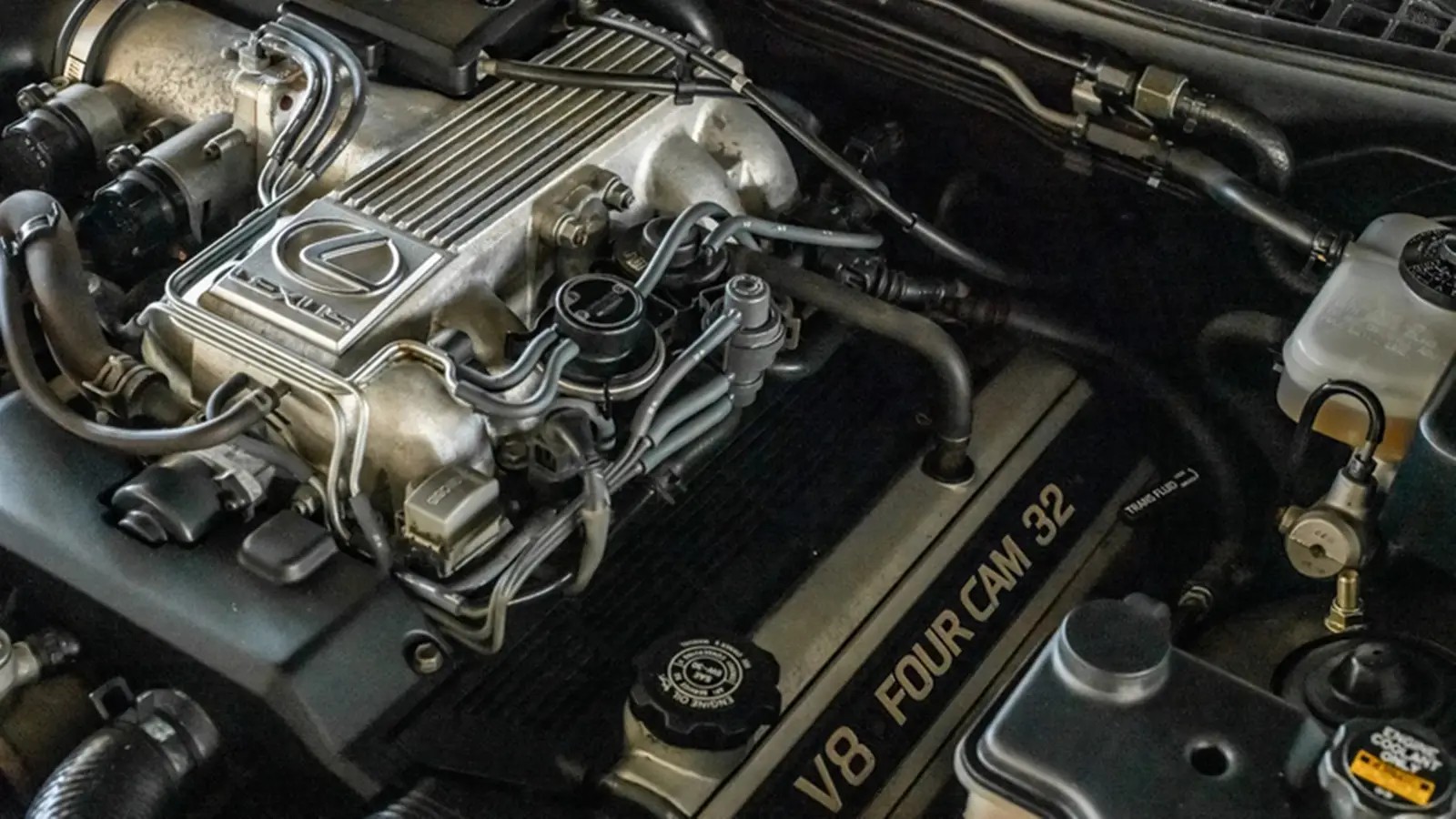
In the modern automotive era, the trend is moving toward small-displacement, turbocharged four-cylinder engines paired with complex hybrid systems. While these setups are efficient, they lack the mechanical simplicity and “bulletproof” longevity that defined a previous generation of engineering.
During the late 1980s and 1990s, Toyota pursued a different philosophy: uncompromising durability through over-engineering. The result was the UZ engine family—a series of V8 powertrains so robust they powered everything from whisper-quiet luxury sedans to heavy-duty work trucks and even small aircraft.
The Billion-Dollar Bet on Simplicity
Reliability is often a byproduct of simplicity. While many manufacturers chase high horsepower through increasingly complex gadgetry, Toyota’s approach focused on thermal management, reinforced internals, and long-term refinement.
The development of the UZ family was not a casual endeavor. Toyota invested approximately $1 billion and dedicated six years to perfecting these engines, utilizing a massive team of 1,400 engineers and 2,300 technicians. Through the testing of 900 prototypes, they sought to create a platform that could withstand decades of use across wildly different vehicle segments.
The 1UZ-FE: Redefining Luxury
The UZ era began in 1989 with the debut of the 1UZ-FE in the Lexus LS 400. At a time when luxury was defined by status, the LS 400 redefined it through mechanical perfection.
To achieve a level of smoothness previously unseen in a mass-produced V8, Toyota utilized a six-bolt bearing design. This heavy-duty construction—typically reserved for racing or industrial engines—drastically reduced noise, vibration, and harshness (NVH). The result was a powertrain that didn’t just move the car; it glided, setting a new global benchmark for what a premium driving experience should feel like.
From Luxury Sedans to Million-Mile Trucks
The true genius of the UZ family lay in its versatility. Toyota realized that the same principles used to make a quiet sedan could also make an indestructible workhorse.
The 2UZ-FE and the Tundra Legend
When Toyota transitioned the UZ architecture into its pickup truck lineup (specifically the Tundra), they made a strategic engineering shift. They moved to a cast-iron block and increased the displacement to 4.7 liters.
Crucially, Toyota “under-tuned” the 2UZ-FE engine. By limiting its power output to roughly two-thirds of its actual potential, they ensured that the internal components were never subjected to extreme stress. This conservative tuning, combined with the heavy-duty block, earned the Tundra a “million-mile” reputation, with many original engines surviving well beyond six-figure mileages.
The 3UZ-FE: Performance and Precision
Not all UZ engines were built solely for low-stress longevity. The 3UZ-FE variant brought a more aggressive character to the family. Featured in models like the Lexus GS 430, this version utilized:
– Variable valve timing for better power delivery across the RPM range.
– Optimized induction systems to ensure consistent torque.
This performance capability extended far beyond the street. The UZ architecture proved its mettle in extreme environments, including:
– Motorsport: Specially tuned 3UZ-FE engines powered Supras to championships in the Japanese Super GT series.
– Aviation: A twin-turbocharged 1UZ-FE was even developed and FAA-certified for use in small aircraft.
– Drag Racing: With forged internals, enthusiasts have pushed these engines to exceed 2,000 horsepower.
A Legacy Across the Lineup
The UZ family’s ability to adapt made it the backbone of Toyota’s most iconic vehicles. Its application spanned a massive spectrum of utility and comfort:
- Off-Road Icons: The Land Cruiser 100 Series used a conservative UZ tune to balance rugged climbing ability with refined highway cruising.
- Reliable SUVs: The Lexus GX 470 and Toyota 4Runner benefited from the engine’s ability to handle heavy loads without sacrificing smoothness.
- Executive Cruisers: The Toyota Crown Majesta and Toyota Celsior (Lexus LS) utilized the engine to maintain their status as pillars of reliability.
The UZ series proved that “rugged” does not have to mean “primitive.” It demonstrated that an engine could be both a high-performance machine and an indestructible tool.
Conclusion
The Toyota UZ engine family represents a pinnacle of automotive engineering where longevity was prioritized over fleeting performance stats. By investing heavily in over-engineered internals and conservative tuning, Toyota created a multi-purpose V8 legacy that continues to dominate the used car market for its unmatched durability.