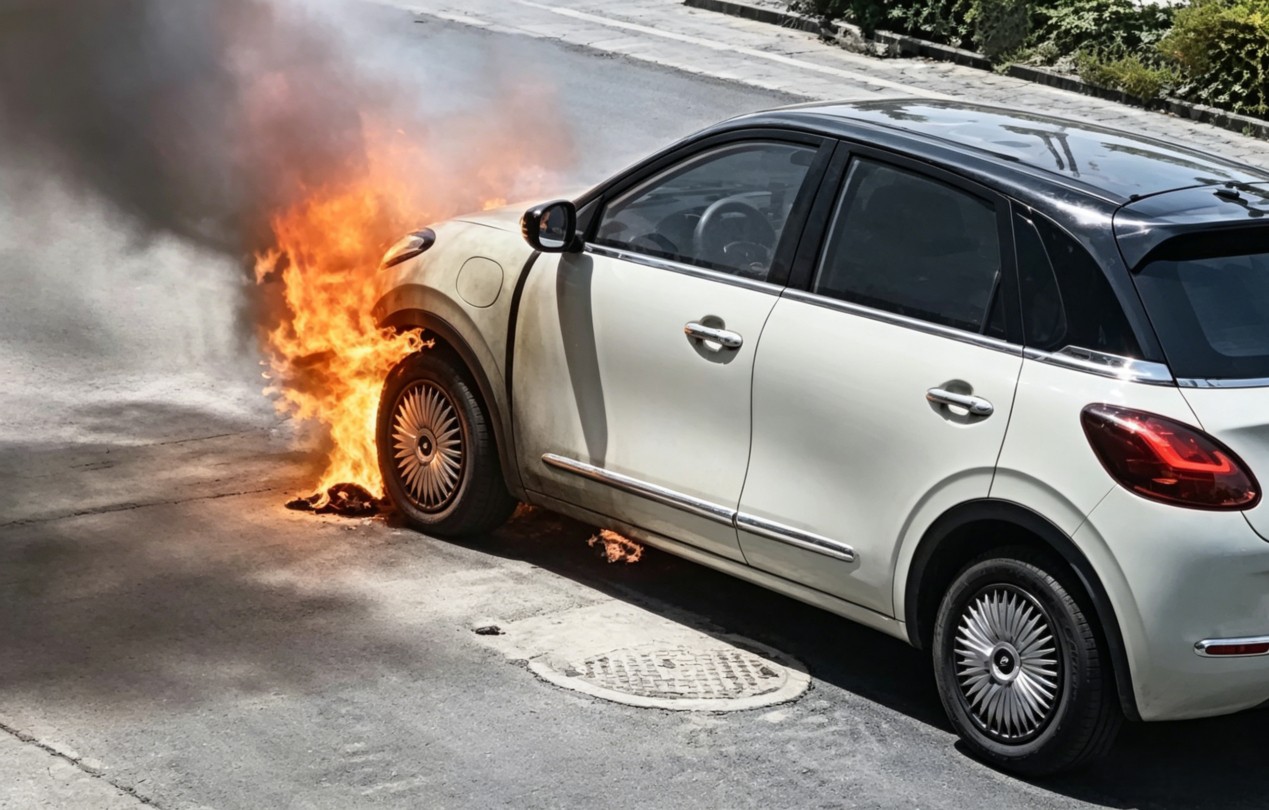
A Wuling Binguo electric vehicle caught fire while parked in Xuancheng, Anhui province, during the May Day holiday, raising immediate concerns about battery safety in China’s competitive entry-level EV sector. The incident occurred on May 3 in a residential-commercial area, with reports indicating that the vehicle was stationary, locked, and not charging at the time.
Although no injuries were reported, the fire caused significant damage to the car and destroyed personal belongings stored inside. Local authorities and Wuling technical teams are currently investigating the cause, with early speculation pointing toward potential battery thermal runaway or electrical system failure exacerbated by high ambient temperatures.
Incident Details and Owner’s Account
According to accounts from the vehicle owner cited by Chinese media outlets, the car had been parked since approximately 8:00 a.m. On that day, the vehicle was not connected to a charging station and had not been driven for roughly three hours prior to the incident.
Around 11:20 a.m., smoke was observed emerging from the area near the left-front wheel and the front compartment. Witnesses alerted emergency services, and firefighters subsequently extinguished the blaze. Photos circulating on social media show the vehicle’s cabin and front structure severely damaged, effectively rendering the car a total loss.
The owner emphasized that the vehicle had not undergone any unauthorized modifications and had not been involved in recent collisions. Beyond the loss of the vehicle, the fire destroyed cash, important documents, and other personal items stored inside.
Key Context: The fact that the fire occurred while the car was parked and not charging is particularly notable. It suggests a potential internal fault rather than an external charging error, a scenario that often draws heightened scrutiny from regulators and consumers alike.
Investigation and Manufacturer Response
Following the incident, Wuling technical personnel arrived at the scene to retrieve relevant vehicle components for analysis. As of now, the company has not issued an official statement confirming the specific cause of the fire.
Local reports indicate that the investigation is ongoing. While high temperatures during the May Day holiday have been cited as a possible contributing factor—potentially triggering thermal runaway in the battery pack—no definitive conclusions have been released by authorities or the manufacturer.
Market Implications for Wuling
The incident has garnered significant attention because the Binguo series represents a crucial product line for SAIC-GM-Wuling. As one of the brand’s higher-profile entry-level electric hatchbacks, the Binguo competes in a highly sensitive segment where safety perceptions can heavily influence consumer trust.
Recently, Wuling has been expanding its presence in this market:
– The Binguo Pro entered presales with a starting price of 58,800 yuan (approx. $8,600 USD).
– The updated Hongguang Mini EV launched at a starting price of 42,800 yuan (approx. $6,300 USD).
These moves highlight Wuling’s strategy to dominate the budget EV segment. However, incidents such as this underscore the challenges manufacturers face in balancing cost-efficiency with rigorous safety standards in mass-market vehicles.
Sales Context and Trends
Wuling’s recent sales figures reflect a period of adjustment in the broader Chinese EV market. According to China EV DataTracker:
– March 2026 Domestic Sales: 50,546 vehicles.
– Year-on-Year Change: A decline of 47.6%.
– Market Share: 3.1% of the total market.
– Binguo Model Sales (March): 5,510 units.
The significant year-on-year drop suggests intense competition and shifting consumer preferences. In this context, safety incidents can have an outsized impact on brand reputation, potentially affecting sales momentum for new models like the Binguo Pro.
Conclusion
The fire involving the parked Wuling Binguo highlights the ongoing scrutiny facing entry-level electric vehicles regarding battery safety and reliability. While the investigation continues, the incident serves as a reminder of the critical importance of thermal management and electrical integrity in mass-market EVs. The outcome of this case may influence consumer confidence in Wuling’s expanding lineup and the broader budget EV segment.