


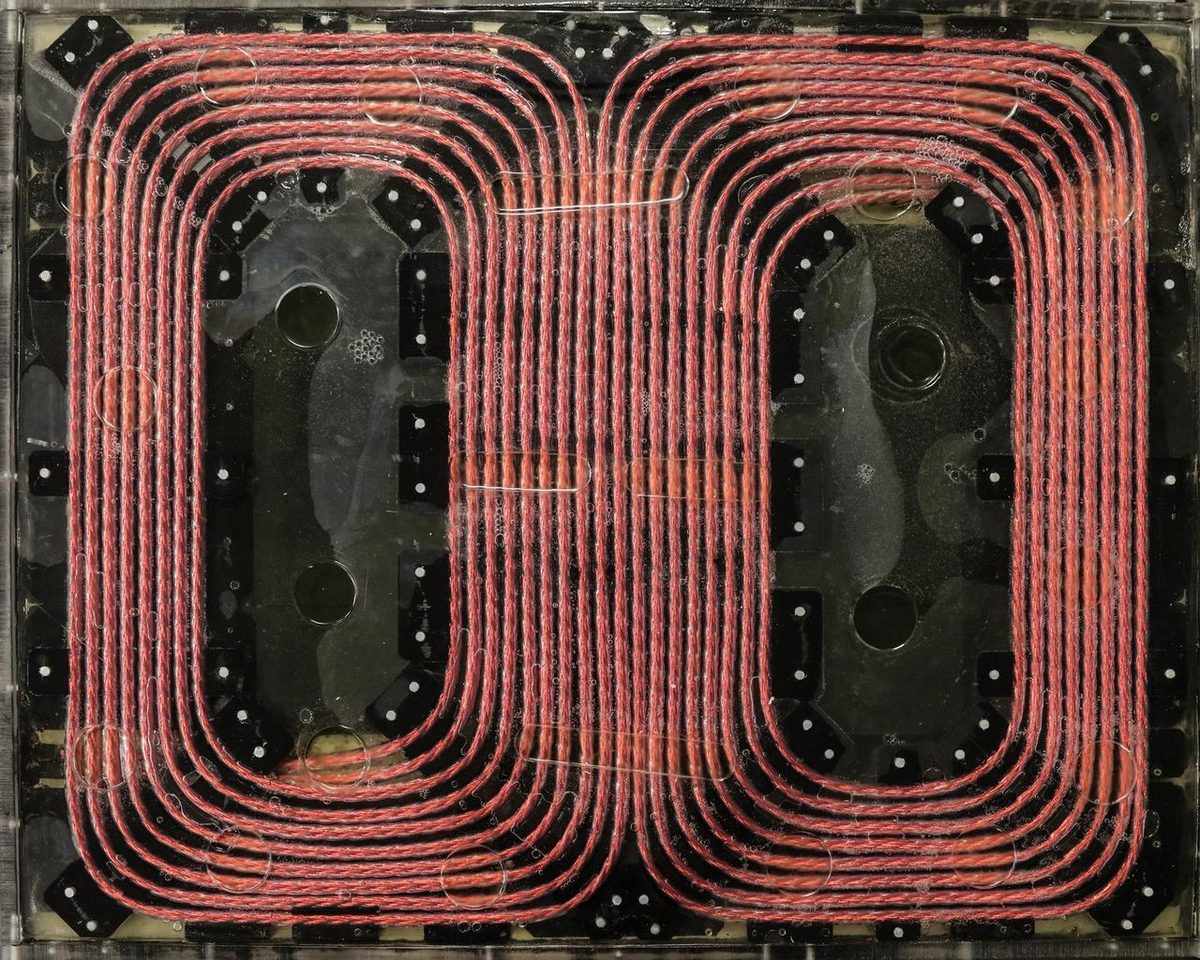
Imagine filling up your tank in minutes. Now imagine doing this without connecting any cables. It sounds like science fiction, but researchers at Oak Ridge National Laboratory (ORNL) have shown that this is no dream. They introduced a wireless inductive charging system that produces 120kW of power with an amazing **97% efficiency. This is very impressive. This is comparable to today’s fastest wired DC fast chargers.
This is a big leap forward. ORNL’s previous system in 2016 had a maximum output of 20 kW. Production increases 6 times. The research team achieved this by combining a new coil design with advanced silicon carbide (SiC) power electronics. The result is a coil that is light, compact and, most importantly, does not overheat. It minimizes power loss during transmission and solves one of the most difficult problems in wireless energy.
How wireless inductive charging works
The mechanism is deceptively simple. This system uses two coils. Place one on the ground or on a charging pad. The other is on the vehicle. Grounding coils receive alternating current from the grid and convert it into a high-frequency alternating current source. This creates a magnetic field that passes through an air gap of about 15 centimeters (about 6 inches).
When the secondary winding of the vehicle enters this magnetic field, the energy is transferred across the gap. This is converted back to direct current (DC) and stored in the car’s battery. There are no plugs. There are no sockets. Just physics.
But ORNL didn’t stop at 120 kW. The goal is to increase this technology to 350-400 kW. Why? Reduce charging time to 15 minutes or less. Even more ambitious is the pursuit of dynamic wireless charging. This means that the road itself becomes the charger. You would pull energy while driving at highway speeds.
The Future of Highway Charging
The concept is clear. The charging coil is buried under the highway asphalt. Electric vehicles (EVs) continuously charge their batteries while driving at speeds between 90 and 120 km/h (55 and 75 mph). This effectively eliminates range issues on long trips. The infrastructure is hidden. The experience is seamless.
But efficiency suffered. Underground coils are less efficient than good old copper cable. But the convenience might be worth the trade-off.
Siemens and BMW test in Berlin
Oak Ridge National Laboratory conducts physics research in Tennessee, and Siemens and BMW conduct logistical testing in Berlin. Starting in June, an inductive charging system will be introduced in the German capital. It uses an underground transmitter to send energy to the vehicle’s coils, eliminating the need for cables.
They use the BMW ActiveE prototype for testing. This is the 100% electric version of the Series 1. The exact technical details of the Berlin test are not yet known, but the focus is on real integration.
This mirrors efforts in the US. Plugless Power is conducting similar tests at Google’s headquarters in California. The race is on to make wireless charging the norm instead of a novelty.
Why Discretion Matters
Why do we have to bother with embedding the coil? Because the current charging infrastructure is ugly. Piles of cables, bulky stations, and public hassle. An underground system is discreet. It blends into the cityscape.
Siemens believes this is important for mass adoption. Electric cars need to be charged more often than gasoline cars. You need a flexible solution. Wireless charging enables automatic charging. Imagine a taxi waiting for passengers. The car is being charged at idle. No driver intervention is required. Don’t waste your time.
Then those who doubt can be converted. If we could stop charging the same way we stop breathing, the barrier to entry would be greatly reduced.
Conclusion
We are approaching the point where wireless electric cars can be charged as fast as gas stations. ORNL’s 120 kW benchmark sets the stage. Siemens and BMW have proven the effectiveness of the presented models. Google is testing this technology in Silicon Valley.
The technology exists. High efficiency. Infrastructure challenges continue. However, the direction is clear. We are moving away from cable. We are moving towards embedded energy.
Can you really charge your car as fast as you pump gas? Maybe not today. But with 350 kW just around the corner, the gap closes fast. The roads are changing. Are you ready?


