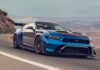
The Ford Mustang. Even for those who don’t follow cars, it’s a name synonymous with accessible performance, American motoring, and the birth of the long-hooded, rear-drive sports car. For six decades, it has evolved dramatically, from optimistic beginnings to periods of decline and resurgence, now aiming for global dominance. This is the story of every Mustang generation – what made each one unique, and what it represented in the pony car’s history.
The Original Pony Car: 1965-1973
The first Mustang debuted in 1964, commissioned by Lee Iacocca to capture the emerging Baby Boomer market. Affordable, customizable, and compact, it quickly became a cultural phenomenon, selling over 400,000 units in its first year. It filled a gap: a car for young professionals driving from city jobs to new suburban homes made possible by the Interstate system. Its appearance in films like Bullitt cemented its iconic status.
The base model came with a modest 2.8-liter straight-six, but the GT variant offered a 225-horsepower V-8. Over the years, performance-focused models like the Mach 1, Boss 302, and Boss 429 emerged, offering aggressive styling and increased power. The Shelby partnership added further prestige, though it would later be discontinued.
Why this matters: The original Mustang didn’t just sell cars; it defined a new segment. It proved that performance didn’t have to be exclusive to luxury brands, opening the door for affordable, powerful vehicles.
Mustang II: 1974-1978
The 1973 oil crisis forced Ford to downsize, resulting in the widely-disliked Mustang II. Based on the Pinto chassis, it was smaller, less powerful (with options ranging from a four-cylinder to a 5.0-liter V-8), and often criticized for its uninspired design. Despite this, it sold over 1.1 million units and even won MotorTrend’s Car of the Year in 1974.
The Mustang II represents a low point in the pony car’s history. It was a product of economic necessity, not performance aspiration. While commercially successful, it lacked the aggressive styling and power that would define later generations.
Why this matters: The Mustang II demonstrates how even iconic brands must adapt to external pressures. It’s a reminder that sometimes, survival means sacrificing identity, even temporarily.
Fox-Body: 1979-1993
The Fox-body Mustang marked a significant turnaround. Built on the versatile Fox platform, it offered a boxy but functional design, with engine options ranging from a four-cylinder to a 5.0-liter V-8. It became a cultural staple, especially the 5.0-liter variant. The Fox-body sold over 2.5 million units during its 14-year run.
The Fox-body wasn’t about luxury; it was about affordable speed. It earned a reputation as the car of choice for those wanting a cheap, reliable, and fast ride. A turbocharged SVO variant provided a unique option, foreshadowing future EcoBoost models.
Why this matters: The Fox-body proved that performance could be attainable without compromising practicality. It set the stage for the Mustang’s resurgence in the 1990s.
SN95: 1994-2004
The fourth-generation Mustang (SN95) brought a more modern, sculpted design. While built on an improved Fox-4 chassis, it wasn’t a radical departure. A 5.0-liter V-8 GT model won MotorTrend’s Car of the Year in 1994, but the SN95 remained a transitional model.
A 1999 facelift sharpened the styling, and the SVT Cobra introduced independent rear suspension, a feature absent for decades. Special editions like the Bullitt and Mach 1 hinted at a return to retro-inspired design.
Why this matters: The SN95 bridged the gap between the utilitarian Fox-body and the more aggressive designs of future generations. It laid the groundwork for Ford to capitalize on nostalgia.
S197: 2005-2014
The S197 Mustang embraced retro styling, becoming an instant hit. Critics praised its throwback design and V-8 options. Ford sold over a million S197 Mustangs in the U.S. alone.
A 2010 refresh sharpened the design, and the 5.0-liter Coyote V-8 became a staple. Shelby variants returned, including the 500-horsepower GT500 and the track-focused Boss 302, pushing the Mustang’s performance limits.
Why this matters: The S197 proved the power of nostalgia. It demonstrated that buyers would respond to designs that evoked the Mustang’s iconic past.
S550: 2015-2023
The sixth-generation Mustang (S550) went global, featuring a more European-influenced design and, for the first time, right-hand drive availability. Independent rear suspension was standardized across all trims.
Engine options included a 310-horsepower EcoBoost four-cylinder and a 460-horsepower Coyote V-8. High-performance Shelbys, like the GT350 and GT350R, pushed performance boundaries, even challenging European sports cars. The GT500 produced 760 horsepower.
Why this matters: The S550 marked the Mustang’s transition from a regional icon to a global player. It proved that the Mustang could compete with established European performance brands.
S650: 2024-Present
The latest Mustang (S650) continues the evolution, with a more angular design and improved performance. The Dark Horse variant offers 500 horsepower, while the GTD reaches a staggering 815 horsepower.
The S650 stands out in a shrinking pony car segment, with the Chevy Camaro discontinued and Dodge ending production of the Charger/Challenger. Ford has even positioned the Mustang to compete with high-end supercars.
Why this matters: The S650 demonstrates Ford’s commitment to keeping the Mustang relevant in an era of electrification and changing consumer preferences. It signals a willingness to push the Mustang into uncharted territory.
The Ford Mustang has survived and thrived for six decades by adapting, innovating, and occasionally leaning into nostalgia. From its humble beginnings to its current status as a global performance icon, the Mustang continues to evolve, proving that some legacies are built to last.