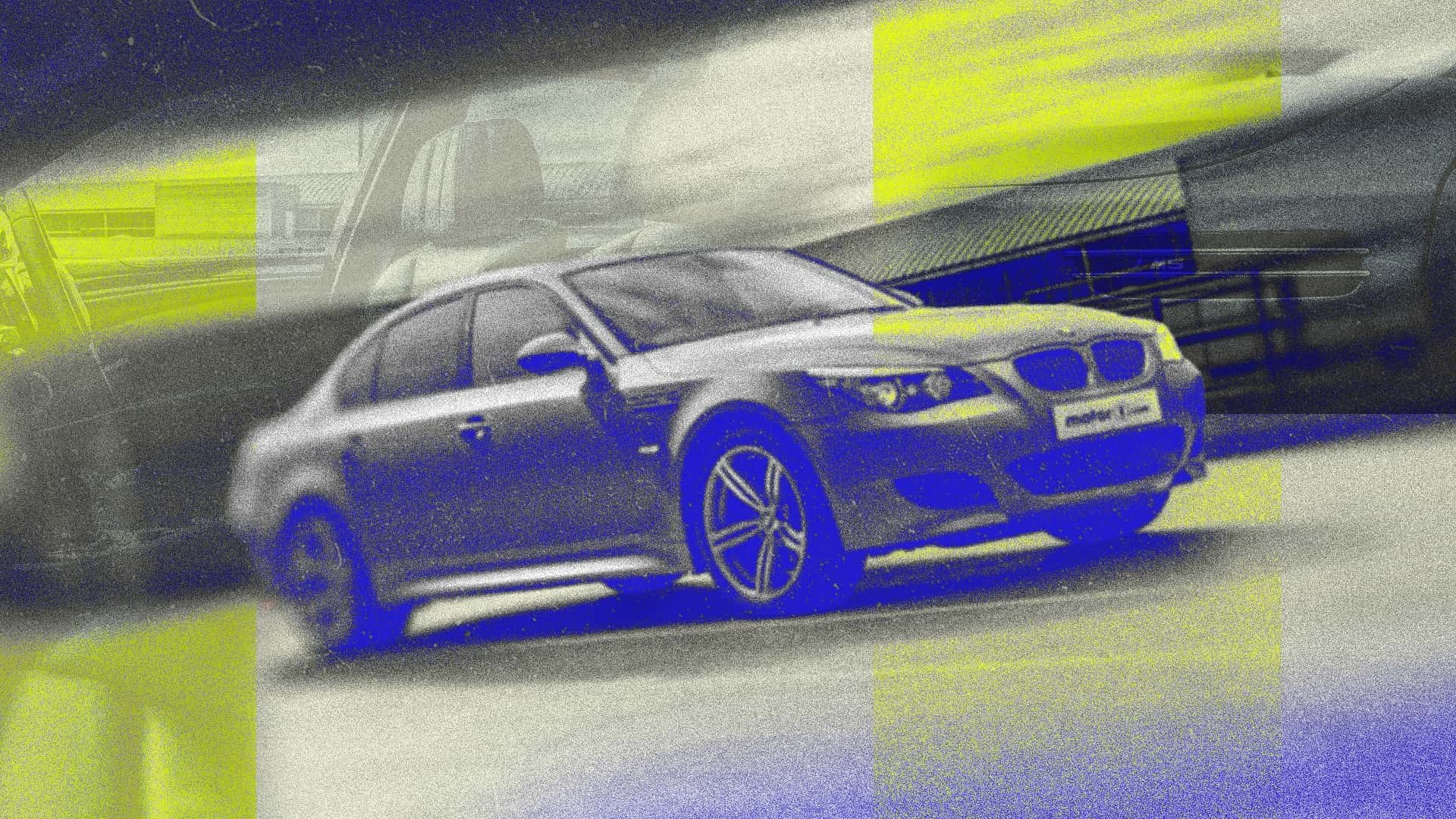
For years, the BMW E60 M5 occupied a strange, uncomfortable space in the automotive world. It was a car that divided opinion instantly: critics lambasted its controversial “Bangle-era” styling, while drivers wrestled with a jerky automated gearbox and the looming threat of expensive maintenance. As Jeremy Clarkson famously noted during its debut, it was a machine that could be “one of the ugliest and most annoying cars in the world,” yet capable of becoming “one of the very best” at the mere touch of a button.
Today, that narrative is shifting. Once maligned, the E60 M5 is entering its “redemption arc.” Recently added to Hagerty’s ‘Bull Market’ list of appreciating classics, this high-performance super sedan is finding a new, dedicated following among enthusiasts who value its singular, high-revving soul.
A Departure from Tradition
To understand why the E60 was so controversial, one must look at what it replaced. Its predecessor, the E39 M5, is widely considered a masterpiece of understated elegance and driver-focused simplicity, featuring a reliable V8 and a standard six-speed manual.
The E60 broke that mold entirely. Under the direction of designer Chris Bangle, the car embraced a provocative aesthetic characterized by flared lines, “eyelash” headlights, and a distinctive trunk shape. Mechanically, BMW traded the traditional V8 for something far more exotic: the S85 V10.
The Heart of a Race Car
The S85 engine is a mechanical anomaly in BMW’s history. Unlike most M engines, it wasn’t derived from a standard production powertrain. Instead, it was a racing-inspired masterpiece developed during the height of BMW’s Formula 1 involvement.
- Performance: It produced 507 horsepower and could scream all the way to an 8,250-rpm redline.
- Technology: It utilized individual, electronically-actuated throttle bodies for each cylinder, providing surgical precision and instant response.
- Speed: This engine allowed the M5 to reach a top speed of 190 mph (and even higher in un-limited versions), making it one of the fastest four-door sedans on the planet at the time.
However, this exotic heart came with a price. The high-strung nature of the V10 requires meticulous upkeep, specifically regarding rod bearings, VANOS solenoids, and throttle actuators—repairs that can be quite costly if neglected.
The Transmission Divide
One of the biggest hurdles for the E60’s reputation was the SMG III transmission. A seven-speed single-clutch automated manual, the SMG was a product of its era—a time when manufacturers were obsessed with mimicking Formula 1 shifting.
While it offered lightning-fast shifts in certain modes, it lacked the smoothness of modern torque-converter automatics and the tactile engagement of a traditional manual. This left the car in an “uncanny valley”: too clumsy for casual city driving, yet not quite engaging enough for pure purists.
BMW eventually addressed this by offering a six-speed manual starting in 2007, but it was primarily restricted to the North American market. This rarity has turned manual E60 M5s into highly coveted collector’s items. Out of tens of thousands of V10 M5s produced, only a small fraction—roughly 1,364—carry the three-pedal manual setup.
Real-World Ownership: Myth vs. Reality
While the car has a reputation for being “scary” to own, long-term owners suggest a more nuanced reality. Petar Vrcelj Nikolic, who has owned a manual E60 M5 for seven years and driven it over 55,000 miles, offers a different perspective.
“My E60 M5 has unironically been the single most reliable car I have owned,” Nikolic says.
His experience suggests that the car is not inherently unreliable, but rather requires disciplined budgeting. His advice for prospective buyers is simple: set aside roughly $7,500 immediately to address preventative maintenance (like rod bearings) to ensure the car is “bulletproof” from day one. He specifically recommends seeking out the “LCI” (Life Cycle Impulse) models, which benefited from refined interior designs and improved engine components like oil squirters.
Why It Matters Now
The E60 M5 is currently experiencing a surge in interest because it represents a “momentary blip” in BMW’s history. Most modern performance sedans have moved toward high-torque V8s and seamless, computer-aided driving. The E60, by contrast, offers something increasingly rare: a high-revving, high-drama V10 paired with a luxury chassis.
As collectors look for cars that offer a distinct character, the E60 M5 stands out as a unique hybrid—a vehicle with the soul of a supercar and the utility of a daily driver.
Conclusion: The BMW E60 M5 has transitioned from a controversial experimental phase into a celebrated modern classic. Its combination of racing-derived V10 power and polarizing design makes it a singular driving experience that is unlikely to be repeated in the era of electrification.