Locking a transmission sounds trivial. You press a button. A metal pin drops. The wheels stop. But the engineering required to make that happen without stripping gears or jacking up your suspension is surprisingly intricate.
Consider the physics involved. When you park on a hill, your car’s weight rests entirely on the drivetrain. The parking mechanism must handle this load without failing. It also has to engage even if the input shaft isn’t perfectly aligned. And once engaged, the lever must stay put. It cannot pop up due to vibration or gravity.
The solution is the parking pawl. It is a simple piece of metal, but its interaction with the transmission output gear is critical.
The Mechanics of Engagement
Most automatic transmissions use a small lever, called the parking pawl, to lock the output shaft. Here is how it works:
- Disengagement on Hills: The pawl must release smoothly even when the transmission is under heavy load from the car’s weight on a slope.
- Misalignment Tolerance: The mechanism allows engagement even if the lever does not line up perfectly with the gear slot. This prevents damage during shifting.
- Positive Locking: Once the pawl engages, a detent or spring mechanism prevents it from popping back out. This ensures the car stays stationary.
The parking pawl engages with a gear on the transmission’s output shaft. When you shift into “Park,” the pawl slides into a tooth of the gear. This physically blocks the shaft from rotating. The wheels stop.
But there is a catch. If you do not apply the brake first, the car may roll slightly before the pawl engages. This can cause a clunk and wear on the metal. Always use the brake.
Why This Matters
Without a parking pawl, your car would not stay parked on an incline. It would roll. The pawl is the final safeguard. It is a small part, but it plays a huge role in vehicle safety.
The next page shows photos of the pawl and gear in action. We will break down exactly how they interact. And why ignoring this system can lead to expensive repairs.
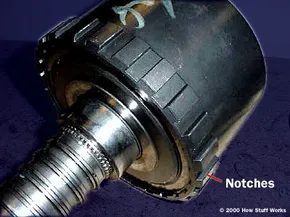
How the parking pawl locks your transmission
The images below break down exactly how the parking mechanism stops your car from rolling away. It’s not magic. It’s simple mechanical interference.
Figure 1 exposes the output section of the transmission. This is the end of the line before the driveshaft takes over. When you click the shifter into “Park,” a small steel finger called a parking pawl drops into the teeth of the output shaft. The gear teeth catch. The shaft stops. If the shaft doesn’t spin, the driveshaft can’t turn. And if the driveshaft doesn’t turn, the wheels stay put.
It is a direct physical block. No hydraulics. No software. Just a piece of metal holding its ground against a rotating gear.
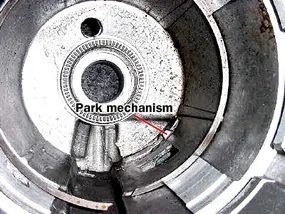
How Tapered Parking Paws Handle Hills
Look closely at the mechanism protruding into the housing where the gears sit. It is not just a flat block of metal. The sides are tapered. This angle is intentional. It solves a specific problem. Parking on a steep incline puts stress on the brake. Without this design, the pawl can get stuck. The tapered sides change the physics. The weight of the car pushes against the gear. That force drives the parking mechanism out of its locked position. The angle helps it disengage. You avoid the struggle of fighting gravity when you try to shift into drive.
“The force from the weight of the car helps to push the parking mechanism out of place because of the angle of the taper.”
Why Geometry Matters for Park Brake Disengagement
Many drivers assume the park pawl is a simple lock. It is more than that. The taper acts as a ramp. When you are parked uphill, the vehicle wants to roll backward. This motion loads the transmission. The pawl takes the hit. If the sides were vertical, the metal would bind. It would jam hard. The tapered design allows the load to lift the pawl slightly. It moves it out of engagement. This happens automatically. You do not need to hold the brake pedal down to prevent the car from crushing the pawl. The geometry does the work.
Preventing Transmission Damage on Inclines
The park mechanism is critical for static holding. But it can cause damage if not designed correctly. A non-tapered pawl can snap under heavy load. Or worse, it can shear off the teeth of the parking gear. The tapered side distributes the force. It guides the mechanism away from the gear teeth. This reduces wear. It also makes starting easier. You are not fighting against tons of vehicle weight. The design ensures smooth disengagement. It protects the transmission internals.
Real-World Implications for Drivers
You might not think about tapered sides when you park. But the engineering matters. If your car struggles to get out of park on a hill, the mechanism might be worn. Or it might lack the proper taper. The design relies on the angle to function. Without it, every incline becomes a potential transmission hazard. The taper ensures the pawl retracts cleanly. It is a small detail. But it prevents expensive repairs. Understanding this helps you diagnose issues. It explains why some cars handle hills better than others.
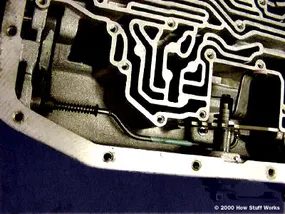
The mechanical link between your shifter and the transmission
Look at the hardware in Figure 3. That’s the rod doing the heavy lifting for the park position. It’s not magic. It’s a cable running straight from the shift lever inside the cabin down to the transmission. When you move the stick, you’re physically pulling or pushing this cable.
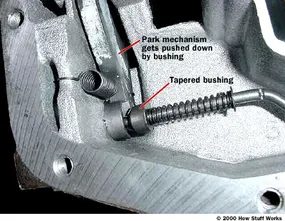
Figure 4 gives us the top-down view of the actual locking mechanism. Here is what happens when you click the shifter into “P.”
The rod pushes a spring against a small tapered bushing. Simple enough. But the rest depends on geometry.
If the mechanism lines up with a notch in the output gear section, that tapered bushing drives the lever down. The gear teeth engage. The car is locked.
But what if the transmission happens to be resting on a “high spot” on the output gear?
The spring still pushes against the bushing. The lever still wants to drop. But it can’t. The teeth aren’t aligned. So the car moves. Just a little. A few inches. Maybe a foot. You release the brake pedal and feel that slight roll. That’s not a defect. That’s physics. The car has to roll just enough for the gears to rotate into position. Once they line up, the parking pawl drops into place.
This is why you often hear a clunk a second after you put the car in park and let off the brake. It’s the sound of the teeth finally settling.
Once that pawl is seated, the bushing holds the lever tight. Even on a steep hill. The mechanical lock keeps the car from popping out of gear. Gravity loses.
The slight roll you feel after engaging park is simply the transmission adjusting its internal position so the locking teeth can mate properly.
Related HowStuffWorks Articles
-
How Automatic Transmissions Work
-
How Manual Transmissions Work
-
How Brakes Work
-
How Emergency Brakes Work
-
How Anti-Lock Brakes Work
-
How Engine Brakes Work