


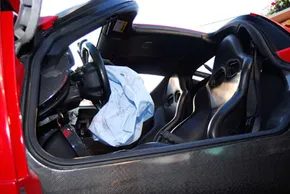
Seat belts used to be the only line of defense. they were working. These laws were debated, especially in areas concerning children, but in the end the coercive laws won out. The information is self-explanatory. Slavery has brought thousands of people out of the grave.
Then came the airbags. Think of it like a soft pillow waiting to be hit. This idea is not new. During World War II, engineers patented an inflatable landing gear for airplanes. It wasn’t until the 1980s that these things became part of everyday driving.
This is now a requirement. Beginning in 1998, all cars sold in the United States required dual front airbags. Trucks followed in 1999. The statistics don’t lie. Front airbags reduce the risk of death in a frontal collision by approximately 30%. This is important.
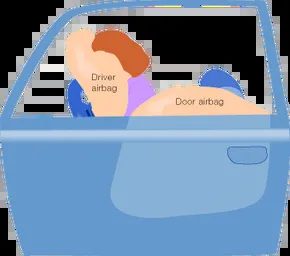
But we didn’t stop there. Also added side impact protection. A bag that attaches to the seat. A bag to hang on the door. Some modern vehicles pack six, eight or even more into one chassis. Like seat belts before them, airbags have met with skepticism. now? This is the focus of intense government and industry scrutiny.
This is science. And mechanics. There is still a future.
Laws of motion
Forget the textbooks for now. Look at the speed. This is the product of mass and velocity. It’s simple enough. A moving object continues to move unless something forces it to stop. If it is a car, you are the owner of the car. There are loose objects. As long as you exist, you exist.
If you are not wearing your seat belt, continue. Even if the car crashes and stops. Your body doesn’t.
It takes strength to stop this momentum. But here’s the problem. The current must work for a certain period of time.
The accident happened quickly. The car stopped immediately. you don’t know. There was little time to react. The goal of the Supplementary Restraint System (SRS) is to reduce the speed to zero. Nothing can break you in this process.
The possibility of an airbag is small. It takes less than a second. And the space between the face and the handle is limited. If you force it to stop, you may be injured. You can survive if you slow down steadily. It’s all about that balance.
Next, let’s look at the components. And how that pillow fills up in milliseconds.
Airbag inflation
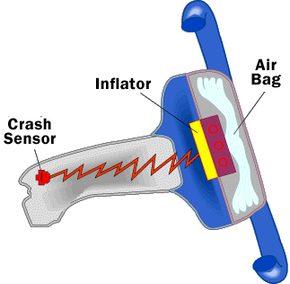

How airbags really work
The goal is not to block you. This is because it slows things down. equally. Less than 1 second.
Three components solve this problem. These work together to prevent users from accessing the dashboard.
The packaging is very simple. Thin nylon fabric. Fold it safely to a new location, such as the steering wheel, dashboard, seat or door. There it is waiting. Silence.
Defines when the sensor is triggered. The expansion starts when the impact force corresponds to hitting a brick wall at a speed of 16-24 km/h. The mechanical clutch changes. Massive change. The electrical contacts are closed. The system knows that a crash has occurred.
It is based on the microchip’s built-in accelerometer. Measure the deceleration. It gets clear enough and the signal disappears.
The inflation system takes over the heavy lifting. Mix sodium azide (NaN3) and potassium nitrate (KNO3). This reaction produces nitrogen. Hot air from the gas fills the bag. Quickly.
Airbags do more than just deploy. It will calculate it for you.
What if the crash is too soft? Nothing happened. What if it’s too hard? The gas fills the bag in milliseconds. Then empty the bag. You slide forward. slowly. controlled.
That’s why airbags are designed to deflate in the event of a collision. They are not shields. A pillow with a timer.
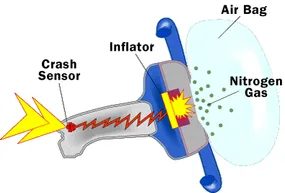

The physics of deployment
Early attempts to install airbags in cars faced cost and technical challenges. The main problem is compressed gas. Storing it. Releasing it. Doing it safely.
Researchers had to ask tough questions.
Is it really possible to install a gas tank in a car without destroying the interior? Can the tank maintain pressure for more than a decade without leaking or exploding? Most importantly, how do you fill the bag fast enough to save a life without an explosion shattering your windshield?
Temperature changes are also a nightmare. Cold weather slows down chemical reactions. Heat speeds them up. Finding a middle ground that works between -20°F and 120°F can seem impossible at first.
The solution is not just to bigger tank. This is chemistry. More specifically, it is a solid propellant that burns at high temperatures and high speeds.
Solid Propellants Take Over
Gas tanks were out. They are heavy, expensive and take up too much space. The industry switched to solid propellants. Think of this as a firecracker inside a module.
When the sensor detects a collision, an electrical signal activates the igniter. The squib ignites the propellant. This is not smoking in the traditional sense. Here’s a quick breakdown.
The reaction produces nitrogen gas. pure nitrogen. Inert. Compared to other by-products, it is safe to inhale in high concentrations.
The volume of the gas expands immediately. The bag fills. Less than 0.03 seconds.
Why nitrogen? It does not react with other substances. It does not support combustion. It’s just… there. Expanding.
The challenge is to manage this expansion. If the bag fills up too quickly, you could bruise your ribs. Too slow to be useful.
Engineers solved the problem with venting. A small hole in the back of the bag lets the gas out when the passenger pushes the bag. This cushions the blow. It turns a rigid barrier into a dynamic shock absorber.
Cost and complexity
The transition to solid propellants solves more than just physics. It slashed costs.
There are no high-pressure steel tanks. No complicated valves required. All you have is the plastic shell, the inflator unit and the bag itself.
Manufacturing is easier. The modules can be stamped and assembled on the same production line as other car parts.
But it’s not perfect. The propellant must be accurately measured. Too much, and you get excessive force. Too little, and the bag doesn’t deploy.
Consistency is key. Every single unit had to work.
Early failures taught the industry a lesson. Simplicity wins. And in safety, simple works every time.
Explosive factor
Remember the ear-splitting bang researchers feared? That’s true.
If you’ve ever watched a crash test video, you hear it. A sharp “pop” sound. Like a shot.
It was the sound of the propellant igniting and the bag rupturing through its packaging.
Modern design dampen this. The module is lined with sound-absorbing material. The trigger sequence has been adjusted to minimize acoustic shocks.
still. It’s noisy.
But how does it compare to a skull fracture or neck fracture? The noise doesn’t matter.
The evolution from gas canisters to solid-state inflators was a turning point. It moved airbags from a luxury prototype into standard equipment.
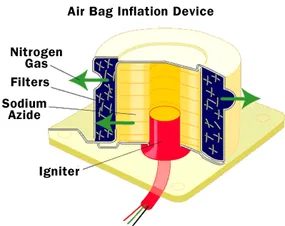

They must find a way to trigger a chemical reaction that produces nitrogen for expansion. Solid-propellant inflators filled this demand in the 1970s.
This system reflects a solid rocket booster. Solid propellant ignites and burns very quickly. As a result, a large amount of gas is produced. This gas causes the bag to burst from its storage location. It can travel at speeds of up to 200 mph (322 km/h). It’s faster than the blink of an eye. In a second, the gas escapes through a tiny holes. The bag is deflates. You can move again.
The whole sequence only takes one-twenty-fifth of a second. There’s hardly enough time to save your life. The powdery substance inside? It is cornstarch or talcum powder. Manufacturers use this to keep the bag flexible during storage.
Understand the forces and locations of airbags
From the beginning, experts have warned that airbags require a seat belt. This technology only works in frontal collisions over 10 miles per hour (6 km/h). Seat belts protect against secondary crashes, rear impacts and secondary crashes. Even with the latest technology, it only works if used with lap/shoulder belt.
If the distance is too close, the applied force may cause damage. Researchers have identified the first 2 to 3 inches (5 to 8 cm) of inflation of the risk zone for driver airbags. Requires 10 inches (25 cm) of free space. Measure the distance from the center of the steering wheel to your sternum.
If you are sit closer, adjust your position.
- Push the seat back as far as possible until you reach the pedals.
- Tilt the seat back a little. Most cars allow this. Helps achieve 10 inches of clearance.
- If the steering wheel is adjustable, tilt the steering wheel down. This will point the bag towards your chest instead of your head.
Rules for children’s safety and decommissioning
For children the rules change. An airbag can injure or kill an unbelted child sitting too close. There is also a danger if the child is thrown forward during emergency braking.
Follow these instructions exactly:
- Children under 12 must travel in the back seat. Use a properly installed, age-appropriate child restraint system.
- If a rear-facing child seat (under 1 year old and under 20 lbs / 10 kg) is equipped with an airbag, never belong in the front passenger seat.
- If your child is at least 1 year old in the front seat, use a forward-facing seat, a booster or a suitable seat belt. Move the seat as far back as possible.
Some owners may request that the airbag be deactivated. This is explained next.
In 1997, the National Highway Traffic Safety Administration (NHTSA) faced a harsh reality. Airbags don’t just save lives. they were killing smaller people. Shorter drivers. The force of deployment was too high for everyone in the cabin. That’s why they released the final rule. This allows manufacturers to depower of airbags by 20 to 35 percent. Less violent. Better for the vulnerable.
But that’s not enough for everyone. Some people can’t sit far enough away. Some may require rear-facing child seats because rear seats do not exist or are impractical. they opened the door for on/off switches.
These are not standard. These are special tools aimed at specific risk groups. You couldn’t just flip a switch because you were nervous. Permission is required.
Who is eligible for deactivation?
The rules are strict. You must enter one of these groups to receive an authorization letter from NHTSA. Without that letter, the repair shop wouldn’t touch it.
For both driver and passenger:
A health condition where the risk of airbag deployment exceeds the risk of the crash itself. Think severe chest deformities or other physical deficiencies where the force of the bag is more dangerous.
Driver side:
This one is about geometry. If you are not at least 10 inches (25.4 cm) from the center of the driver’s airbag cover to properly operate the car, you may be covered. Medical issues plus this spatial constraint.
Passenger side:
There are two main scenarios here.
1. Transport babies in forward-facing and rear-facing car seats. This is the case if the car does not have a back seat, the back seat is too small for the seat, or if you need to constantly monitor your child’s health.
2. Children between the ages of 1 and 12 must ride in the front seat. Again, only if there are no rear seats, the number of children exceeds the capacity of the rear seats, or if constant medical supervision is required.
Pay attention to the pattern. This has nothing to do with comfort. This is because the vehicles are physically unable to meet safe distance and emergency medical needs, and the vehicles do not have the space to meet standard safety protocols.
The Paperwork Hurdle
If you think this is an easy trip to the parts counter, you’re wrong. Certain processes are required.
First, you’ll need NHTSA’s pamphlet, Airbags and Switches: Information for Making Informed Decisions. In addition to this, you also need the Request for Airbag On-Off Switch * form.
Where can I find these?
– The NHTSA website.
– AAA club.
– New-car dealers.
– State Department of Motor Vehicles.
Please fill out the form. Submitted to NHTSA for review. If accepted, you will receive an acceptance letter. Take this letter to a repair shop.
Talk to a dealer or professional before starting the extensive paperwork process. Check if Switch is available for a specific make and model. If not, the process may be different.
Retrofit Requirements
If you want to install a retrofit on/off switch, federal law is unforgiving. The switch must be operated by a key. No keyless nonsense. It should also have a warning light that indicates whether the bags are on or off.
These safety features aren’t optional. Prevents accidental deactivation. They ensure you know the status of your passive safety system.
What About Medical Conditions?
This is where people get confused. Just because you have a medical problem doesn’t mean your airbag should go off.
A group of doctors from the National Conference on Medical Indications for Air Bag Deactivation reviewed the flood of letters sent to the National Highway Traffic Safety Administration. They focused on common complaints. They said no to a lot of people.
The prerequisites are:
– pacemaker
– Wear glasses
– Angina pectoris
– emphysema
– Asthma
– Previous mastectomy
– You have had back or neck surgery before
– old age
– Osteoporosis
-arthritis
– Pregnancy
These cannot be disabled. The risk of an airbag deployment is still considered lower than the risk of a crash without an airbag. Airbags are designed to deploy with enough force to overcome resistance. In most situations, this force is manageable.
The 10 inch rule
Even if the switch is there, don’t turn it off unless it’s necessary. If you can sit back 10 inches, stay put.
Airbags are highly explosive devices. This is not a pillow. Gas buffer created in milliseconds. If approached, the pressure can cause severe facial fractures, eye injuries and internal injuries.
For those who cannot achieve this distance, reducing the distance is the only logical option. The risk of injury caused by the bag is greater than the risk of collision.
Factory and change
You may notice the difference here. Factory installed switches are permitted under limited circumstances. Only if the vehicle does not have a rear seat or if the rear seat is too small for a rear-facing child seat.
What about the drivers? in no way. Manufacturers are not allowed to install driver airbag switches on new vehicles.
Why? NHTSA is concerned about a code violation. If every new car had a switch on the dashboard, people would turn it off for convenience. They had their feet on the dashboard. They sit very close to each other. Airbags are also an option.
They are also concerned about engineering resources. Combining switches and redesigning dashboards distracts from developing safer and more advanced airbag systems. It is better to make airbags safer for everyone than to make it easier for people to escape.
Individual exceptions
What if the car is old? What if the manufacturer does not offer a retrofit on/off switch?
NHTSA issues a permit on a case-by-case basis. Even if the criteria are met, the license can still be granted if there are no approved switches on the market. This is not a guarantee. This is a review process.
But there is one absolute rule. Do not attempt to disable the airbag yourself.
This is not a DIY project. The airbag module contains explosives. If not handled correctly, you may injure yourself or others. This system is based on precise timing and electrical integrity. We don’t have the tools to replicate it.
Airbags are serious engineering. It can save lives. But for some people it is dangerous. The deactivation rules reflect this tension. There is a reason for its hardness. They balance the protection needs of the many with the survival needs of the few.
The future of airbags
The discussion did not stop there. As sensors become smarter. As cameras improve. Airbags have also developed. But that’s another story.

Millisecond Math for side impact protection
Side collisions cause 30% of all accidents, but 40% result in serious injuries. Until recently, the automotive industry focused on front and rear collisions. This is changing. Car manufacturers have reinforced door frames and roof structures, but the real innovation is the side airbags.
Front airbags are easy. The bumper, bonnet and engine absorb the initial energy. It takes 30-40 milliseconds for this force to be transmitted to the passenger. The Side impacts are terrible. There are no crumple zone. There are only thin doors and a few inches between you and other cars. The airbags must deploy within 5–6 milliseconds. This is the difference between life and death.
Seat-Back vs. Door-Mounted Designs
Volvo engineers decided that seat-back mounting was the best solution. Protects passengers of all sizes regardless of seating position. They installed a mechanical sensor in the seat cushion that acts as a trigger. This prevents the airbag on the unaffected side from inflating. It also prevents unnecessary triggering due to minor collisions with pedestrians or cyclists. For these devices to activate, the collision must occur at approximately 12 miles per hour (19 km/h).
BMW chose another path. They chose the door-mounted airbags. The door frame adds volume. This can accommodate larger bags and covers a wider area.
Head protection: ITS and curtain airbags
The biggest risk in side collisions is head injury. Head airbags are known as Inflatable Tubular Structure (ITS) and look like long sausages. It stays in the air for about 5 seconds. This prevents secondary or third impacts. It works in conjunction with side airbags to protect passengers.
Another option is curtain airbag. The purpose of both systems is to prevent the heads from hitting windows or intruding vehicle components. The science is still new. Progress is happening quickly as designers analyze real-world crash data and improve these life-saving benefits.


