
The anxiety over rising hyperbranched aminosilica applications is less about the tech and more about the timeline. We know the drill. Carbon dioxide levels are climbing. Climate scientists agree humans are a major factor, even if you still hear arguments that it is all a natural cycle. We are riding that wave whether we like it or not. To slow the drift, researchers are hunting for fuels that do not release CO2 the way gasoline does.
Biofuels like cellulosic ethanol from corn or switchgrass help. They cut emissions by up to 85 percent compared to fossil fuels. That is significant. But it is not zero. Hydrogen is cleaner. Burn it in an engine and the only output is water. Electricity from wind or solar is even better because it produces no emissions at the point of use. The catch is maturity. These technologies are still being developed. They face stiff hurdles like high costs and poor net energy ratio. You put more energy in to make the fuel than you get out of burning it.
Oil still runs the world. It powers the airplanes, the freight trucks, and the power plants. It dominates the global economy. So the question becomes obvious. If we cannot escape oil yet, why not capture the CO2 it releases?
That is exactly what Professor Chris Jones and his team at the Georgia Institute of Technology are investigating. They developed a material called hyperbranched aminosilica (HAS). It captures and stores carbon dioxide emissions. The big question remains. Will we see tailpipes made of this material soon? And what exactly is HAS?
Understanding Hyperbranched Aminosilica
The name is a mouthful, but the concept is straightforward. HAS is a chemical structure designed to grab CO2 molecules. It acts like a sponge for carbon emissions. The team at Georgia Tech engineered this specific material to address the gap between current oil dependency and the need for lower greenhouse gas emissions. It is not a fuel replacement. It is an emission control strategy.
The material works by interacting with the exhaust gases. Instead of letting CO2 escape into the atmosphere, HAS binds to it. This process stores the carbon in a stable form. It prevents the gas from contributing to the greenhouse effect. The technology is still in the research phase. It is not something you can bolt onto your current vehicle today. But it represents a shift in how we think about internal combustion engines.
Why focus on capture instead of conversion? Because the infrastructure for oil is too entrenched to replace overnight. Changing the entire global supply chain from crude oil to hydrogen or renewable electricity takes decades. Capturing emissions at the source offers a bridge. It allows existing systems to operate with a smaller climate footprint.
The science behind HAS relies on its chemical composition. The “aminosilica” part refers to silicon-oxygen bonds with amine groups attached. These amine groups are reactive. They have a high affinity for carbon dioxide. The “hyperbranched” structure increases the surface area available for these reactions. More surface area means more CO2 captured per unit of material. This efficiency is critical for making the technology viable in automotive applications.
The Practical Challenges of Carbon Capture
There is no free lunch in engineering. HAS faces the same obstacles as other alternative fuel technologies. Cost is the biggest barrier. Producing specialized chemical
Why Power Plants Beat Cars in Carbon Emissions
Let’s get the math straight. You might assume the exhaust pipe is the biggest problem. It isn’t. In the US, coal accounts for 50 percent of the energy behind the grid. Globally, power generation drives 26 percent of CO2 emissions. Transportation? Just 13 percent. Cars are a symptom. Smokestacks are the source.
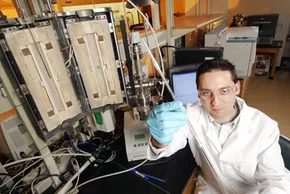
That is why Dr. Chris Jones at the Georgia Institute of Technology is not looking at your tailpipe. He is looking at the flue gases coming out of industrial chimneys. The material in question is hyperbranched aminosilica, or HAS. It looks like white sand. It is a powder. But inside, the structure is complex.
Jones and his team used covalent bonding to link amines (nitrogen-based organic compounds) with silica (quartz). The result creates a tree-like structure with many branches. At the tips of these branches sit amino sites. These sites are designed to grab CO2 molecules and hold them tight.
How the Capture Process Works
When flue gas passes through this compound, the CO2 gets trapped. It sticks. It does not drift away. To get it back, you have to heat the material. Once released, the carbon dioxide can be captured and stored. This is carbon sequestration.
But it is not just about burying the gas. There is a use case. In Louisiana, a company grows algae for biofuel. They feed the algae captured CO2. The algae grow. The fuel is made. The cycle repeats.
This approach has distinct advantages over older methods. First, it is recyclable. The Georgia Tech team tested a single batch 12 times. There was no noticeable drop in adsorption capability. Second, it handles moisture well. Water vapor is always present in flue gases, which usually kills other capture methods. HAS does not care. Finally, the energy input is low. The only energy required is the heat needed to release the CO2 later.
The Engineering Hurdles
It is not a perfect solution yet. There are friction points. The reaction between CO2 and the amine sites generates heat. The material works best at cool temperatures. So the engineers face a thermal management problem. They need to remove that generated heat quickly to keep the binding efficient.
Then there is the physical application. How do you put this in a smokestack? Do you pack it in like sand? Do you create removable discs that seal the stack openings? These are practical engineering questions that remain open.
The Bottom Line
Will your car have a HAS tailpipe? Probably not. Storing carbon from every individual vehicle is too costly and inefficient. The scale is wrong.
But if Georgia Tech can clean up the smokestacks, the impact is massive. You are targeting the biggest source of emissions, not the smallest. It is a different strategy. It is a bigger swing. And if they can solve the heat and application issues, it is a viable path to lowering global CO2 levels. The algae in Louisiana are already growing. The question is whether the smokestacks will follow.