Your tires are likely the most critical component on your entire vehicle. They are the only parts that actually touch the ground. Everything else is just cargo. The engine makes power, the drivetrain sends it, but the tires are what convert that rotational force into linear motion. Without that connection, you have a very expensive stationary object.
This connection is called tire traction. In technical terms, traction is the frictional resistance between the tire tread and the road surface. It happens in reaction to the torque being applied by the wheel axle. When the engine pushes the wheel, the tire pushes the road. The road pushes back. That push back is what moves you.
It is a simple mechanical exchange, but it is absolute. You can have 700 horsepower. You can have a perfect tuned intake and exhaust. If your tires cannot bite into the pavement, that horsepower is useless. You will just spin your wheels and burn through tread.
This is why the phrase “the rubber meets the road” is not just a cliché. It is a literal description of where force is transferred.
What is the role of tread in generating grip?
People often think more tread means more grip. In some cases, that is true. In others, it is the opposite.
Tread pattern matters for moving water away. A slick tire has maximum contact patch. It has the most rubber touching the ground. On a dry day, a slick tire has more traction than a performance tire with grooves. The grooves reduce the actual area of rubber in contact with the asphalt.
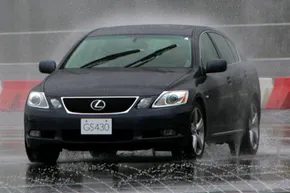
However, that same slick tire will hydroplane instantly on a wet street. The water has nowhere to go. The tire lifts off the surface. Traction vanishes. So, the “best” traction setup depends entirely on the surface. Dry asphalt favors maximum rubber contact. Wet roads need channels to eject water.
Why does torque application matter for tire slip?
Traction is not a static force. It is a dynamic limit.
Every tire has a maximum traction coefficient. This is often referred to as the “grip limit.” If you apply torque to the wheel that exceeds this limit, the tire slips. It spins faster than the car moves.
This is why launch control exists in modern cars. It manages the amount of torque delivered to the wheels. It keeps the tire operating right at the edge of its traction window. Just enough slip to be fast. Not so much slip that you lose forward motion.
If you are driving a high-torque turbocharged sedan, you understand this. You can take the power out of the car simply by being too aggressive on the throttle. The engine makes the power. The tires decide if you get to use it.
How to maintain proper tire traction
Traction degrades. It is not a permanent state. It is a condition you must maintain.
- Tire pressure is non-negotiable. Under-inflated tires have too much contact patch. The edges overheat. The center bulges. Traction becomes uneven. Over-inflated tires have too little contact. The center wears out. You lose grip on turns. Check your pressure when the tires are cold.
- Tread depth is a safety factor. Once your tread is below 4/32nd of an inch, wet weather traction drops significantly.