


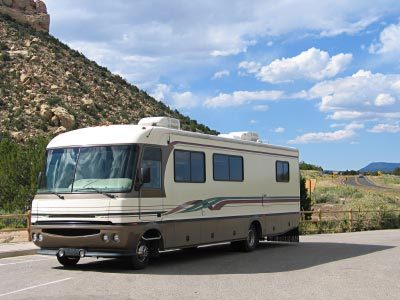
You know when you’ve stuffed too much into a hatchback. Load a few boxes of ceramic tile into the cargo area of a subcompact, and the rear suspension squats hard. The front end lifts as the rear bumper drops toward the pavement. It’s an obvious visual cue that the small car isn’t built for that kind of payload.
Pickups and SUVs handle more. You’d need several more boxes of tile to make a truck squat noticeably. They are designed to carry significantly heavier loads. But what about a massive recreational vehicle? Unless you bought an abnormal amount of tile, you likely wouldn’t even know the boxes were there unless you looked inside. Big RVs are built to carry a lot of weight, but “a lot” has a specific limit.
So how do you determine if you’re overloading an RV? These rigs carry furniture, appliances, televisions, and people, often lots of them. The short answer is that you need to know the vehicle’s cargo carrying capacity, or CCC. The long answer involves a bit of simple math and specific definitions. Here is how to calculate an RV’s cargo carrying capacity.
The Math Behind the Limit
To find the CCC, you start with the vehicle’s gross vehicle weight rating (GVWR). This is the maximum weight of the vehicle, including passengers, cargo, and fluids. In our example, let’s assume a GVWR of 20,000 pounds.
From that number, you subtract four specific weights:
- Unloaded Vehicle Weight (UVW) : This is the manufacturer-provided weight of the vehicle with a full tank (or tanks) of fuel, coolant, and oil. In our example, the UVW is 14,500 pounds.
- Sleeping Capacity Weight Rating (SCWR) : This is a maximum weight determined by multiplying 154 pounds by the number of sleeping positions. If your RV has 6 sleeping positions, the SCWR is 924 pounds (6 x 154).
- Propane Fuel (LP Gas) : Propane weighs 4.2 pounds per gallon. If your tanks hold 12 gallons, the weight is 50.4 pounds (12 x 4.2).
- Fresh Water : Water weighs 8.3 pounds per gallon. If you have 25 gallons of fresh water on board, that adds up to 207.5 pounds (25 x 8.3).
The result is the cargo carrying capacity of the vehicle.
The Calculation:
20,000 (GVWR) – 14,500 (UVW) – 924 (SCWR) – 50.4 (LP Gas) – 207.5 (Fresh Water) = 4,318.1 pounds
That 4,318.1 pounds is your CCC. It is a hard weight limit. The manufacturer sets this for safety, and it should never be exceeded.
Where to Find Your Specific Numbers
Curious about your own vehicle’s cargo capacity? The manufacturer should be able to provide this data. Most manufacturers publish this and other important vehicle information online, so an internet search is often the fastest route.
There is a common point of confusion here. Many online charts list “Cargo Carrying Capacity” in cubic feet (ft³) rather than pounds. For example, a 2006 Acura MDX is listed with a cargo capacity of 81.5 ft³, while a 2007 Audi A3 is listed at 54.6 ft³. A 2009 BMW X5 has a volume of 61.8 ft³.
Volume is space. Weight is load. Knowing your cargo volume doesn’t tell you if your suspension will fail or if you are exceeding your GVWR.
If you are hauling heavy items like generators, toolboxes, or pallets of tile, volume is irrelevant. You need the weight-based calculation. The lists of models from Acura, Audi, and BMW provide useful spatial references, but for weight limits, stick to the GVWR, UVW, SCWR, and fluid weights.
Why does this matter? Because unlike a hatchback, you won’t see the sag until it’s too late. The structure takes the hit before the eyes see it.
Buick and Cadillac: Trunk Space by Model Year
The numbers here are straightforward. You are looking for cubic feet of usable space behind the rear seats. If you are hauling gear, the difference between a sedan and an SUV is night and day.
Buick kept its lineup relatively stable from 2006 to 2009. The LaCrosse stayed at 16 cubic feet throughout the period. The Lucerne offered slightly more, sitting at 17 cubic feet. Neither will swallow a full-size suitcase set.
Where things get interesting is the crossover and MPV segment. The Rainier held steady at 80.1 cubic feet for 2006 and 2007. Then it vanished. In its place, the Enclave arrived in 2008 with 116.2 cubic feet. By 2009, that number dipped slightly to 115. The Rendezvous (2006-2007) pushed 108.9 cubic feet, while the Terraza (2006) maxed out at 136.5.
Cadillac offered a wider range of options. The CTS started at 12.5 cubic feet in 2006 and 2007 before jumping to 13.6 in 2008 and 2009. The DTS remained consistent at 18.8 cubic feet. The STS and XLR models hovered between 11.6 and 13.8 cubic feet, with the STS at 13.8 and the XLR at 11.6.
The big players were the Escalades. The standard Escalade grew from 104.6 cubic feet in 2006 to 108.9 in 2007 and stayed there through 2009. The Escalade ESV followed suit, moving from 131.6 to 137.4 cubic feet. The SRX held at 69.5 cubic feet for 2006-2008. In 2009, the list got a bit messy with an “Escalace Hybrid” listed at 69.5 and the SRX dropping to 13.8, which seems like a data error in the source, but the previous years clearly show the SRX as a mid-size SUV with significant cargo space.
Chevrolet: The Volume King
Chevy dominated this era in terms of raw cargo capacity. The Express van is the standout, offering 225.1 cubic feet in 2006, 2007, and 2008. In 2009, the breakdown became more specific with Express 1500, 2500, and 3500 all listed at 225.1 cubic feet.
Pik-ups like the Silverado (1500, 2500, 3500) and Avalanche are listed with dashes for cargo capacity. This is standard; those numbers apply to the bed, not a closed trunk. The Colorado is also listed as unavailable.
SUVs tell a different story. The Tahoe and Suburban 1500/2500 both hit 137.4 cubic feet starting in 2007. The TrailBlazer offered 80.1 cubic feet in 2007, 2008, and 2009. The TrailBlazer EXT was a 107.4 cubic foot option in 2006. The Equinox varied slightly, starting at 68.6 in 2006 and settling at 67.1 for 2007-2009.
The HHR is a niche case. In 2006, it offered 63.1 cubic feet. By 2007, that dropped to 57.7, with the HHR Panel variant offering 62.7. This continued through 2009.
Sedans? The Corvette jumped from 22.4 cubic feet in 2006 to 11 in 2007 and 2008, then back to 22.4 in 2009. The Malibu ranged from 15.1 to 15.4. The Impala stayed at 18.6. The Aveo saw a drop from 42 (2006) to 12.4 (2007-2008) before returning to 42 in 2009. The Cobalt was a consistent 13.9. The Monte Carlo was unavailable in 2006, then 15.8 in 2007.
The new Traverse entered in 2009 with 117.5 cubic feet, a strong number for a mid-size SUV.
Chrysler: Minivans and Crossovers
Chrysler’s lineup leaned heavily on the minivan segment. The Town & Country was the big one, offering 146.7 cubic feet in 2006, dropping slightly to 144 in 2007, and 143.8 in 2008-2009.
The Pacifica and PT Cruiser swapped positions in the data. In 2006, the Pacifica was 62.7 and the PT Cruiser was 92.2. In 2007, the PT Cruiser dropped to 62.7 while the Pacifica jumped to 92.2. In 2008, the Pacifica was 62.7 and the PT Cruiser was 92.2. In 2009, the Pacifica disappeared from the list, and the PT Cruiser was 62.7. This inconsistency suggests model year changes or data entry variations in the source.
The Aspen SUV was a 2007-2009 model, offering 102.4 cubic feet. In 2009, an Aspen Hybrid was added, also at 102.4 cubic feet.
Sedans and coupes remained modest. The 300 and 300C offered 15.6 cubic feet in 2006-2007, jumped to 17.2 in 2008, then back to 15.6 in 2009. The Sebring was 11.3 in 2006 and 13.6 in 2007-2009. The Crossfire was tiny, at 6.5 cubic feet in 2006-2007 and 7.6 in 2008.
Dodge: The Ram and Viper Comparison
Dodge’s lineup is split between massive cargo vehicles and small sports cars. The Sprinter vans are the heavy hitters. The Sprinter Van 2500 and 3500 offered 247 cubic feet in 2006. By 2007, the numbers changed significantly: the 2500 went to 318, and the 3500 to 371. The Sprinter Wagon 2500 dropped from 321 in 2006 to 141.3 in 2007, where it stayed through 2009.
The Grand Caravan was a solid minivan option, offering 167.9 cubic feet in 2006-2007, then dropping to 144.3 in 2008-20
Comparing 2006-2009 Ford Cargo Capacity by Model and Year
You want to know how much stuff fits in a 2008 Ford F-150 or a 2007 Crown Victoria. The answer isn’t always in the brochure. It’s buried in the fine print of cargo carrying capacity (ft3).
Ford’s lineup in this era was messy. Some models had consistent data. Others didn’t. The E-Series cutaways stayed huge. The trucks went quiet.
Ford Sedans and Crossovers: 2006 to 2009
The Crown Victoria is a favorite for taxi fleets and police. Why? The trunk. It holds 20.6 cubic feet every year from 2006 to 2008. Reliable. Boring. Effective.
The Taurus shifts a bit. 17 ft3 in 2006. 21.2 ft3 in 2008 and 2009. A small bump, but noticeable if you haul golf bags.
The Focus dropped hard. 40.2 ft3 in 2006 and 2007. Then 13.8 ft3 in 2009. That’s a massive loss of space. If you’re looking at a used 2009 Focus for hauling, check the exact trim. The data here suggests a significant reduction in the standard model.
The Fusion stayed at 15.8 ft3 across all four years. The Mustang? 9.7 ft3. Four years straight. It’s a coupe. Don’t expect miracles.
The GT lists 1 ft3. That’s almost a joke. A niche model with almost no storage.
Ford SUVs and Trucks: Where the Numbers Disappear
The Escape held steady at 66.3 ft3 for 2006 and 2007. 2008 dropped to 66 ft3. 2009’s Escape Hybrid bumped to 66.1 ft3. Tiny changes.
The Edge appeared in 2007 with 69.6 ft3. It dropped to 69 ft3 in 2008 and stayed there.
The Explorer is the workhorse. 85.8 ft3 in 2006, 2007, 2008, and 2009. Consistent. The Explorer Sport Trac sat at 44.4 ft3 from 2007 to 2009.
The Expedition is the big one. 108.2 ft3 in 2007 and 2008. 108.3 ft3 in 2009. The Expedition EL stretches that to 130.8 ft3 for 2007 and 2008.
The Taurus X showed up in 2008 with 85.5 ft3. It stayed there in 2009.
The Flex debuted in 2009. 83.2 ft3.
Now, the trucks. The F-150, F-250, F-350, and F-450 all list a dash (-) for cargo capacity in 2006 through 2009. This is frustrating. These are trucks. They have beds. The data provided doesn’t give you the cubic feet for the truck beds. It only covers the passenger cabin or trunk equivalent for closed-body models. If you need bed volume, this table fails you.
The Ranger lists 18.1 ft3 in 2006 and 2008. No data for 2007 or 2009.
The E-Series cutaways are the kings of space here.
- 2006: E-150, E-250, and E-350 all offer 256.5 ft3.
- 2008: The number drops to 230.6 ft3 for all three.
- 2009: Still 230.6 ft3.
That’s a 25.9 cubic foot drop between 2006 and 2008. Why? Likely a change in chassis or panel length. If you’re buying a used 2006 E-350 for a mobile workshop, that extra 25.9 ft3 matters.
GMC Cargo Space: The Yukon vs. The Sierra Gap
GMC’s data is cleaner but sparse on trucks.
The Yukon is consistent. 63.6 ft3 in 2006. 60.3 ft3 from 2007 to 2009. The Yukon XL stays at 45.7 or 45.8 ft3. A small drop in 2006, then stable.
The Yukon Hybrid appeared in 2008 with 16.9 ft3. That’s tiny compared to the gas model. The hybrid battery eats space.
The Envoy holds 43.7 ft3 across all four years.
The Acadia started at 19.7 ft3 in 2007, jumped to 25.5 ft3 in 2008, and stayed there.
The Savana vans are massive. 225.1 ft3 for the 1500, 2500, and 3500 in 2006, 2007, 2008, and 2009. No change. Ever.
The Sierra 1500, 2500, and 3500? All dashes. Again, no bed data. The Canyon is a dash too. If you need to compare truck bed volume, this source is a dead end.
Honda: The Civic’s Trunk Shrinkage
Honda’s numbers tell a story of shifting priorities.
The Odyssey is the giant. 147.4 ft3 in 2006, 2007, 2008, and 2009. Unchanged.
The Pilot sits at 87.6 ft3 for 2006, 2007, and 2008. Drops slightly to 87 ft3 in 2009.
The CR-V is a disappointment at 10.4 ft3. Same for all four years.
The Civic is where it gets weird. 72 ft3 in 2006. 72.9 ft3 in 2007. Then 35.7 ft3 in 2008. And 11.5 ft3 in 2009.
Wait. 72 ft3? That’s huge for a compact sedan. Check the specs. The 2006 Civic might have had a wagon or hatchback variant included in this aggregate number, or the data is mislabeled. The 2009 number of 11.5 ft3 aligns with a standard sedan trunk. The drop suggests a model change or data error. If you’re buying a 2006 Civic for cargo, verify the body style.
The Accord drops from 12.8 ft3 (2006) to 14 ft3 (2007), then 11.9 ft3 (2008 and 2009).
The Element holds 74.6 ft3 from 2006 to 2008.
The Fit jumped to 41.9 ft3 in 2007 and 2008, then 57.3 ft3 in 2009. A massive increase. Why? The 2009 Fit likely had a different roofline or fold-down mechanism.
Hummer, Hyundai, Infiniti, Isuzu, and Jaguar: The Niche Players
HUMMER is simple. H2 is 30.7 ft3. H3 is 29.5 ft3. Every year. 2006 to 2009. The H3T has no data.
Hyundai’s Accent went from 12.4 ft3 (2006) to 15.9 ft3 (2007-2009). The Sonata stayed at 16.3 ft3 from 2006 to 2009. The Santa Fe grew from
Jeep cargo volume compared: Commander vs. Wrangler Unlimited
The 2006 Jeep Commander sits near the top of the early 2000s trio with 68.7 cubic feet. That barely changes through the model years, settling at 68.5 by 2008 and staying there. The Grand Cherokee holds steady at 67.4 cubic feet across 2006, 2007, 2008, and 2009. Consistency is boring, but useful if you are hauling the same gear every weekend.
The Liberty drops slightly in later years. It starts at 69.0 cubic feet in 2006 and 2007, then settles into 64.2 cubic feet for the 2008 and 2009 models. The Wrangler is the outlier here. The standard 2006 Wrangler offers just 45.8 cubic feet. By 2007, that jumps to 61.2 cubic feet, and the 2008 Wrangler Unlimited pushes it to 86.8 cubic feet. If you need space but want the short wheelbase feel, look at the standard body. If you need the bed, take the Unlimited.
How much room does a Kia Sedona actually provide?
Kia’s mid-2000s lineup is messy on paper, but the Sedona dominates the cargo charts. The 2006 model claims 141.5 cubic feet. That number drops to 121.3 in 2007 and stays at 121.3 in 2008. It is a minivan-shaped cargo bay, and it shows.
The Sorento and Sportage hover around 66.4 and 66.6 cubic feet, respectively. The 2009 Borrego enters the scene with 97.6 cubic feet, likely benefiting from a longer wheelbase or different interior packaging. Smaller cars like the Rio and Spectra 5 offer around 52.8 cubic feet, while the Rio sedan itself is tight at 11.9 cubic feet. The Optima holds at 14.8 cubic feet for four straight years. Predictable.
Land Rover cargo capacity: Why did the LR3 data look weird in 2008?
The 2006 and 2007 LR3 lists 90.3 cubic feet. The Range Rover sits at 74.9, and the Range Rover Sport at 71.0. Then 2008 happens. The LR3 drops to a nonsensical 9.9 cubic feet in this dataset. The Range Rover also dips to 35.1. This is likely a data entry error or a specific trim variant issue, not a real-world shrinkage of 80 cubic feet.
By 2009, the LR3 returns to 90.3 cubic feet. The new LR2 appears with 58.9 cubic feet. The Range Rover Sport remains unchanged at 71.0 cubic feet throughout the period. If you are comparing SUVs, ignore that 9.9 figure. It breaks the pattern.
Lexus GX 470 vs. LX 470 cargo space breakdown
The Lexus lineup splits between tight sedans and large SUVs. The ES 350 and GS models hover between 7.5 and 15.9 cubic feet. The SC 430 is the smallest at 8.8 cubic feet.
The utility lives in the SUVs. The GX 470 is a workhorse with 77.5 cubic feet in 2006, 2007, 2008, and 2009. The LX 470 offers 90.4 cubic feet in 2006 and 2007. The 2008 and 2009 LX 570 shifts the number to 83.1 cubic feet, a drop of nearly 7 cubic feet. The RX 350 sees a strange dip to 38.3 cubic feet in 2008 before recovering to 85.0 in 2009. That 2008 dip is another outlier worth double-checking before you buy based on spec sheets alone.
Lincoln Navigator: The biggest cargo bay in this dataset
The Lincoln Navigator is a land yacht. The 2006 model packs 104.8 cubic feet of cargo space. It dips slightly to 103.5 in 2007 and 2008, then bounces back to 104.7 in 2009. The Town Car sedan sits at 21.1 cubic feet for all four years. The MKX, a mid-size SUV, holds steady at 69.0 cubic feet.
The Mark LT offers 47.9 cubic feet. The Zephyr and MKZ are compact sedans with roughly 15.8 cubic feet. If you are moving furniture or loading a boat trailer, the Navigator is the only option here that clears 100 cubic feet without feeling like a van.
Mazda cargo capacity: From MPV to MX-5
Mazda’s range is wide. The 2006 MPV leads with 127 cubic feet, a minivan-style figure. The CX-9, introduced in 2007, brings 100.7 cubic feet to the table and keeps it through 2009. The CX-7 sits at 58.6 cubic feet.
The Mazda6 is a mid-size sedan, but the cargo numbers are weird. It starts at 58.7 cubic feet in 2006. That is huge for a sedan. By 2009, it drops to 16.6 cubic feet. This is likely a data error in the source, as a Mazda6 trunk is not 58 cubic feet. The Mazda3 ranges from 31.2 to 43.8 cubic feet, depending on the body style (likely hatch vs. sedan). The MX-5 is a roadster. 5.3 cubic feet. That is your storage capacity. Pack light.
Mercedes-Benz cargo space: C-Class vs. G-Class vs. R-Class
The Mercedes lineup is dense. The C-Class and E-Class sedans offer roughly 12 to 16 cubic feet. The SLR McLaren is tight at 7.2 to 9.6 cubic feet. The ML series (ML320, ML350, ML500, ML63 AMG) is consistent at 72.4 cubic feet across all years.
The G-Class (G500, G55) adds 79.5 cubic feet in 2007 and 2008. The GL series (GL320, GL450, GL550) sits at 83.3 cubic feet. The R-Class, a luxury MPV, offers 85 cubic feet. The S-Class varies slightly, from 15.4 to 19.8 cubic feet. If you need off-road capability with decent cargo space, the G-Class is the standout.
Mercury cargo volume: Monterey and Mountaineer
The Mercury Monterey is the cargo king of the Ford family here. It claims 134.3 cubic feet in 2006 and 2007. The Mountaineer, a full-size SUV, sits around 83.7 to 85.8 cubic feet. The Mariner is a mid-size crossover with 66.3 cubic feet, though it dips to 29.3 in 2007 before returning to 66.3 in 2008.
The sedans (Grand Marquis, Milan, Sable, Montego) range from 15.8 to 21.2 cubic feet. The 2009 Mountaineer drops to 83.7 cubic feet. If you are comparing the Monterey to the Lincoln Navigator, the Navigator wins on volume, but the Monterey is close. Both are large vehicles with large trunks.
When spec sheets contradict each other or show drastic, unexplained drops in cargo volume, verify with a physical measurement before making a purchase decision.
Nissan Cargo Capacity: 2006 to 2009 Data
If you are sizing up a used Nissan for a family road trip or a large appliance run, the numbers vary wildly between the sporty coupes and the massive minivans. The Nissan cargo carrying capacity chart for this era shows a clear divide. The 350Z stays tiny at 4.1 cu ft across all years, fitting only a golf bag and maybe a duffel. The Altima dropped from 15.6 cu ft in 2006 to just 7.4 cu ft in 2008, a significant cut that catches many buyers off guard.
For actual hauling, look at the Quest. It held steady at 148.7 cu ft in 2006, dipped to 145.7 cu ft in 2007, and recovered to 148.1 cu ft for 2008 and 2009. The Armada maintained a consistent 97.1 cu ft throughout the four years. The Murano started strong at 81.6 cu ft in 2006 and 2007 but dropped to 64 cu ft by 2009.
The Rogue introduced in 2008 offered 98 cu ft that year, though that figure dropped sharply to 28.9 cu ft in 2009. The Titan and Frontier do not have listed cargo space for these years in this dataset. The GT-R, appearing in 2009, offers 8.8 cu ft. The Xterra held at 65.7 cu ft every year from 2006 to 2009. The Versa launched in 2007 with 50.4 cu ft and maintained that figure in 2009, though it listed at 95 cu ft in 2008.
Pontiac and Porsche Trunk Space Comparison
Pontiac had a wide range of bodies in this period. The Montana SV6 was a giant at 136.5 cu ft in 2006. The Torrent hovered between 68.6 cu ft and 32.2 cu ft depending on the year, with 2006, 2008, and 2009 all at 68.6 cu ft. The Grand Prix was inconsistent, ranging from 57 cu ft in 2006 down to 16 cu ft in 2007, then jumping back to 45.7 cu ft in 2008.
On the performance side, the Solstice never exceeded 7.5 cu ft. The G6 stayed around 11 to 14 cu ft, while the GTO offered just 7 cu ft in 2006. The G8, available from 2008, provided 17.5 cu ft.
Porsche data is sparse but precise. The Cayenne is the workhorse here, consistently offering 62.5 cu ft from 2006 through 2009. The 911 and Boxter are tight. The Boxter has 9.9 cu ft in 2008 and 2009. The 911 Carrera in 2009 offers 7.24 cu ft. The Cayman provides 14.5 cu ft in both 2008 and 2009. The 2008 911 has no listed cargo capacity in this dataset.
Saab, Saturn, and Smart City Car Capacity
Saab models offered moderate space for their class. The 9-7X SUV held 80.1 cu ft in every year from 2006 to 2009. The 9-5 was stable at 15.9 cu ft. The 9-3 varied, starting at 14.8 cu ft in 2006, rising to 15 cu ft in 2007 and 2008, and dropping to 12.4 cu ft in 2009. The 9-2X offered 61.6 cu ft in 2006.
Saturn had some surprising entries. The Relay was huge, offering 26.9 cu ft in 2006 and jumping to 136.5 cu ft in 2007. The Outlook provided a massive 115.9 cu ft in 2007, 2008, and 2009. The VUE dropped from 63.8 cu ft in 2007 to 56.4 cu ft in 2008 and 29.2 cu ft in 2009. The Sky coupe was tiny, ranging from 5.4 cu ft to 7.5 cu ft (though 7.5 is listed for Pontiac Solstice, Saturn Sky is 5.4 in 2007-2009). The Aura and Aura Hybrid hovered between 13.1 cu ft and 14.9 cu ft.
The smart fortwo, entering in 2008, offers exactly 12 cu ft. It is not a hauler, but it fits a few suitcases for a city weekend.
Subaru and Suzuki Utility Vehicle Cargo Specs
Subaru was the reliability king of this era, and their cargo space reflects their practicality. The B9 Tribeca held 74.4 cu ft in 2006 and 2007, dropped to 104 cu ft in 2008, and returned to 74.4 cu ft in 2009. The Forester started at 57.7 cu ft in 2006, jumped to 68.6 cu ft in 2007 and 2008, and has no listed data for 2009.
The Outback numbers are confusing. It started at 33.5 cu ft in 2006, dropped to 11.4 cu ft in 2007, jumped to 98 cu ft in 2008, and settled at 65.4 cu ft in 2009. The Legacy wagon offered 66.2 cu ft in 2006, 65.4 cu ft in 2007, and 93 cu ft in 2008. The Impreza wagon and Outback Sport generally hovered around 44.4 to 61.6 cu ft.
Suzuki had a large range. The XL7 was a big box, offering 75.1 cu ft in 2006 and 95.2 cu ft in 2007 and 2008. The Grand Vitara jumped from 24.4 cu ft in 2006 to 68.9 cu ft in 2007 and 2008. The SX4 launched in 2007 with 64 cu ft and dropped to 54 cu ft in 2008 and 2009. The Reno offered 8.8 cu ft in 2006 and 45.4 cu ft in 2007 and 2008. The Forenza stayed at 12.4 cu ft throughout. The Equator, Equator, and XL7 have no 2009 data in this list.
Scion and Mitsubishi Final Specs for 2006-2009
Scion, Toyota’s youth brand, kept its numbers tight. The tC coupe was always 12.8 cu ft. The xB, a quirky boxy wagon, offered 43.4 cu ft in 2006, jumped to 69.9 cu ft in 2008 and 2009. The xA provided 32.8 cu ft in 2006. The xD launched in 2008 with 35.7 cu ft.
Mitsubishi data covers the Eclipse, Endeavor, Galant, Lancer, Outlander, Raider, and Montero. The Eclipse is consistently small at 15.7 cu ft. The Galant is 13.3 cu ft. The Lancer is 11.3 cu ft in 2006 and 11.6 cu ft in 2008 and 2009.
The Outlander is the standout SUV here. It offered 60.3 cu ft in 2006, dropped to 36.2 cu ft in 2007, and rebounded to 72.6 cu ft in 2008. The Endeavor was 76.4 cu ft in 2006
How much cargo space does a 2006-2009 Toyota actually have?
The numbers vary wildly depending on the body style. You are not buying a “Toyota” when you are buying a Camry. You are buying 16.7 cubic feet of trunk space. That is it.
If you need to haul gear, a 2008 Toyota Sequoia gives you 120.8 cubic feet. The Sienna maxes out at 148.9 cubic feet across all years listed. It is a van. It does the job.
The RAV4 stays consistent at 73 cubic feet from 2006 to 2009. The 4Runner holds 75.1 cubic feet. Tight. Usable.
The Matrix is interesting. It jumps from 53.2 cubic feet in 2006 to 61.5 in 2009. A significant bump for a hatchback. The Highlander sees a massive jump in 2008, going from 80.6 to 95.4 cubic feet. That is a lot of extra space for one model year.
Trucks like the Tacoma and Tundra do not list cargo capacity in this dataset. They are for cargo, not cargo.
Comparing Volkswagen cargo volumes against Japanese rivals
Volkswagen is efficient. The 2006 VW Golf and GTI both offer 41.8 cubic feet. That beats the Toyota Camry by a wide margin. The Jetta is stingy at 16 cubic feet, matching the Camry exactly.
The Beetle Convertible is nearly useless for cargo. Five cubic feet. That is a small duffel bag. The Coupe does better at 27.1 cubic feet.
The 2009 VW Tiguan arrives with 56.1 cubic feet. It competes with the RAV4 but loses by a mile. The Routan is a different beast entirely, offering 141 cubic feet. It is an MPV. It carries more than the Toyota Highlander, which is impressive for a European import.
The Passat Wagon holds 61.8 cubic feet. The R32 in the 2008 lineup drops to 43.4 cubic feet, likely due to performance-oriented interior packaging. The Touareg stays steady at 71 cubic feet.
Is Volvo cargo space worth the premium?
Volvo tends to prioritize passenger comfort over raw volume, but the wagons change that equation. The 2006 C70 is tiny at 12.8 cubic feet. The S40 follows closely at 14.3.
The V50 offers 62.9 cubic feet in 2006. It dips slightly to 62.6 in 2008 and 2009. The V70 is a solid performer, hovering around 71.4 to 72.1 cubic feet. The XC70 matches the V70 almost exactly, sitting between 71.4 and 72.0 cubic feet.
The XC90 is the biggest Volvo here. It starts at 84.9 cubic feet in 2006 and nudges up to 85.1 in subsequent years. It beats the Toyota Highlander in 2006 (39.7 ft3) but loses to the 2008 Highlander (95.4 ft3).
The S60 jumps from 36.5 cubic feet in 2006 to 13.9 in 2007. That is a drastic drop. Did the design change? Or is the data inconsistent? Check your sources before you buy. The S80 remains a sedan, stuck around 14.4 to 14.9 cubic feet.
Why these specs matter for your next purchase
Cargo capacity is not just a number on a spec sheet. It is the difference between fitting a full set of golf clubs and leaving them behind. It is the difference between a weekend trip and a move.
Look at the 2009 Toyota Land Cruiser at 81.7 cubic feet. Compare it to the 2007 FJ Cruiser at 66.8. The Land Cruiser wins for utility. The FJ Cruiser wins for style.
The 2009 VW Jetta Sport Wagon offers 66.9 cubic feet. That is more than the Toyota Camry Hybrid (10.6 ft3) by a factor of six. If you drive a hybrid, you are trading space for fuel economy. That is a choice.
Do not assume a larger car means more cargo. The 2006 Toyota Avalon has only 14.4 cubic feet. The 2007 Avalon jumps to 41.4. Then it drops back to 14.4 in 2008. That kind of variance suggests model-specific changes in trunk design or measurement standards.
When shopping, measure your actual gear. A 50-cubic-foot number means nothing if you cannot fit your specific load. Check the floor height. Check the wheel wells. The number is the starting point, not the end.


