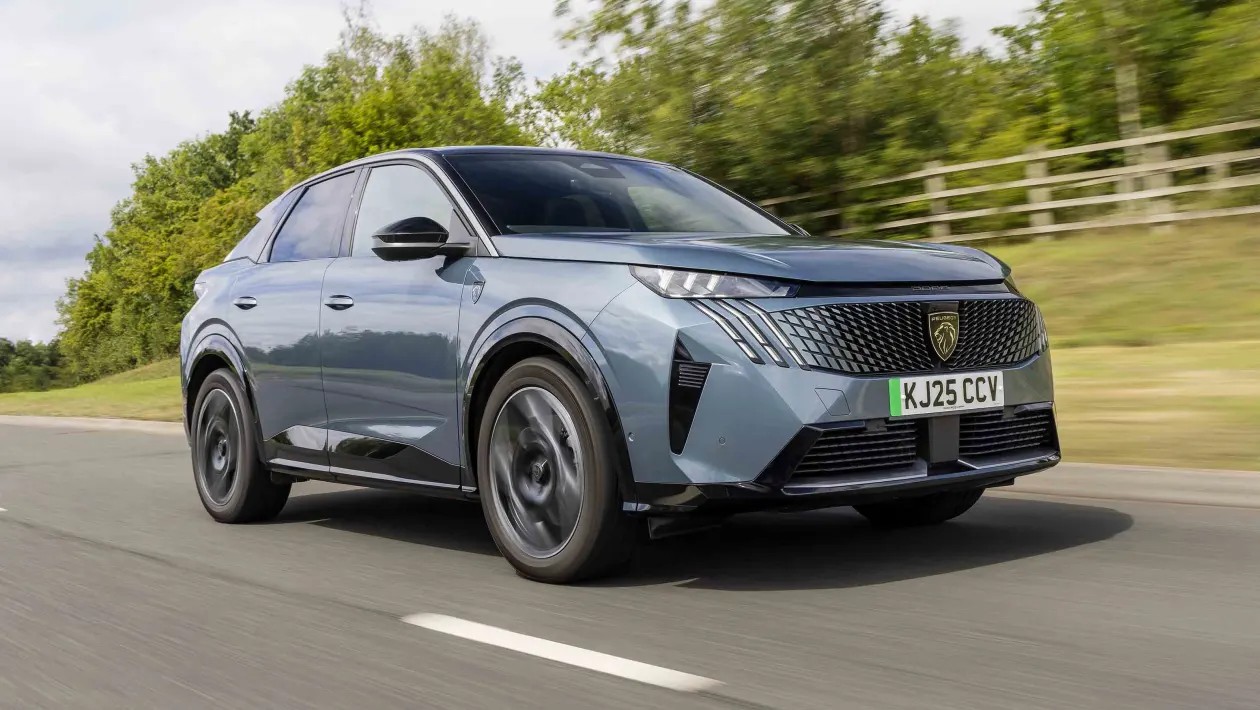
The Peugeot E-3008 looks sharp. It handles well enough on paper. But drive it for a week and you notice the compromises.
It is spacious. The interior design is arguably the best in its class. Yet the car does very little to change the game for family electric vehicles. The ride is too firm. The performance feels muted compared to rivals like the Skoda Enyaq or Tesla Model Y.
So why buy it? Strong finance deals. And for many drivers, the cabin experience outweighs the mechanical quirks.
How does the Peugeot E-3008 drive?
Sporty styling suggests agility. The reality is different. The E-3008 feels competent rather than exciting.
The standard single-motor model produces 211bhp. It feels sprightly in town. Acceleration tails off significantly as speeds climb past 30mph. You won’t feel pinned to your seat. The Long Range version adds a modest 17bhp (228bhp total). It prioritizes efficiency over speed.
The dual-motor all-wheel-drive version changes the equation. With 321bhp, it hits 62mph in 6.0 seconds. That is hot-hatch territory. But the car weighs nearly 2.2 tonnes. All that mass sucks the urgency out of the acceleration. It is quick. It is not thrilling.
There is a tactile issue with the steering. A distinct “stiction” sensation lingers just off center. In sport mode, the weight increases. The feeling becomes gloopy. It undermines the otherwise quick steering ratio.
The ride firmness is a bigger complaint. Peugeot has tuned the suspension stiff. Bumps translate directly to the cabin. Potholes raise concerns about alloy damage. It settles down on the motorway, where weight keeps it planted and noise insulation is excellent. But around town, it unsettles you.
What is the real-world range and charging speed?
Range is where the E-3008 shines. The Long Range model boasts a claimed 435 miles. The standard 73kWh version offers 326 miles. Both figures beat many competitors.
Real-world testing yields lower numbers, but still impressive results. We averaged 4.2 miles per kWh on mixed routes. That translated to roughly 307 miles from the 97kWh battery. In our long-term test of the 73kWh GT trim, the average dropped to 3.9 miles/kWh. That is about 285 miles per charge.
Charging speeds are above average. The car supports up to 160kW DC charging. It beats the Renault Scenic (150kW). It lags behind the Tesla Model Y and Hyundai Ioniq 5, which charge faster.
A useful feature called E-Routes helps plan trips. It considers distance, traffic, and charging station locations. You access it via a connected mobile device. It removes the stress of long-distance travel.
One oversight disappoints. A heat pump is a £700 option on most trims. It is standard only on the top-spec GT Premium. Given the impact of climate control on EV range, this feels like a missed opportunity for standard inclusion.
How practical is the interior and boot space?
Step inside. The E-3008 cabin feels luxurious. The dashboard swoops dramatically around the driver. Materials are high quality. Piano black plastic is minimized. Fabric trim on the dash adds texture. Ambient lighting creates a soft glow.
This design approach distinguishes it from rivals. Many competitors use flat dashboards and identical touchscreen positions. Peugeot’s “i-Cockpit” layout feels futuristic.
The i-Cockpit features a small steering wheel and high-set instrument dials. It takes adjustment. Drivers used to conventional wheels might find it odd initially. In an SUV with a higher seating position, the wheel blocks less of the view. It works better here than in hatchbacks.
Rear space is adequate. Adults fit comfortably. It is not as spacious as some rivals. The sloping roofline sacrifices headroom for style.
The boot holds 588 liters with seats up. Fold them down and you get 1,663 liters. This is competitive. It beats the Renault Scenic’s 445 liters. It trails the Skoda Enyaq’s 585 liters (585-1710L depending on spec). The high center console eats into perceived space.
Is the Peugeot E-3008 expensive to own?
Running costs vary. Insurance groups range from 32E to 40E. The entry-level Allure starts at group 32E. The dual-motor GT Premium sits at group 40E. This is higher than the Skoda Enyaq, which starts at group 27E.
Tax is favorable. Any E-3008 under £50,000 pays £10 VED in the year of registration. Thereafter, it is £200 annually. Watch for changes. A proposed eVED pay-per-mile scheme starts in April 2028. Costs may rise significantly from April 2029.
Depreciation is the weak point. The E-3008 retains only 38% of its value over three years or 36,00 miles. Compare that to the Renault Scenic (54%) or Nissan Ariya (42-51%). You will lose money faster than with many rivals.
Final verdict
The Peugeot E-3008 offers a stunning interior and competitive range. The design stands out in a sea of generic SUVs. Long-distance charging is manageable.
But the driving experience holds it back. The firm ride. The sticky steering. The lack of genuine performance thrill despite strong paper numbers.
It is not a bad car. It is just not exceptional. The strong finance deals make it an attractive option. If you prioritize cabin aesthetics over driving dynamics, it works. If you want engagement, look elsewhere.
The market offers better alternatives for pure driving pleasure. But for style-conscious families needing range, the E-3008 remains a viable candidate. Just accept the trade-offs.