


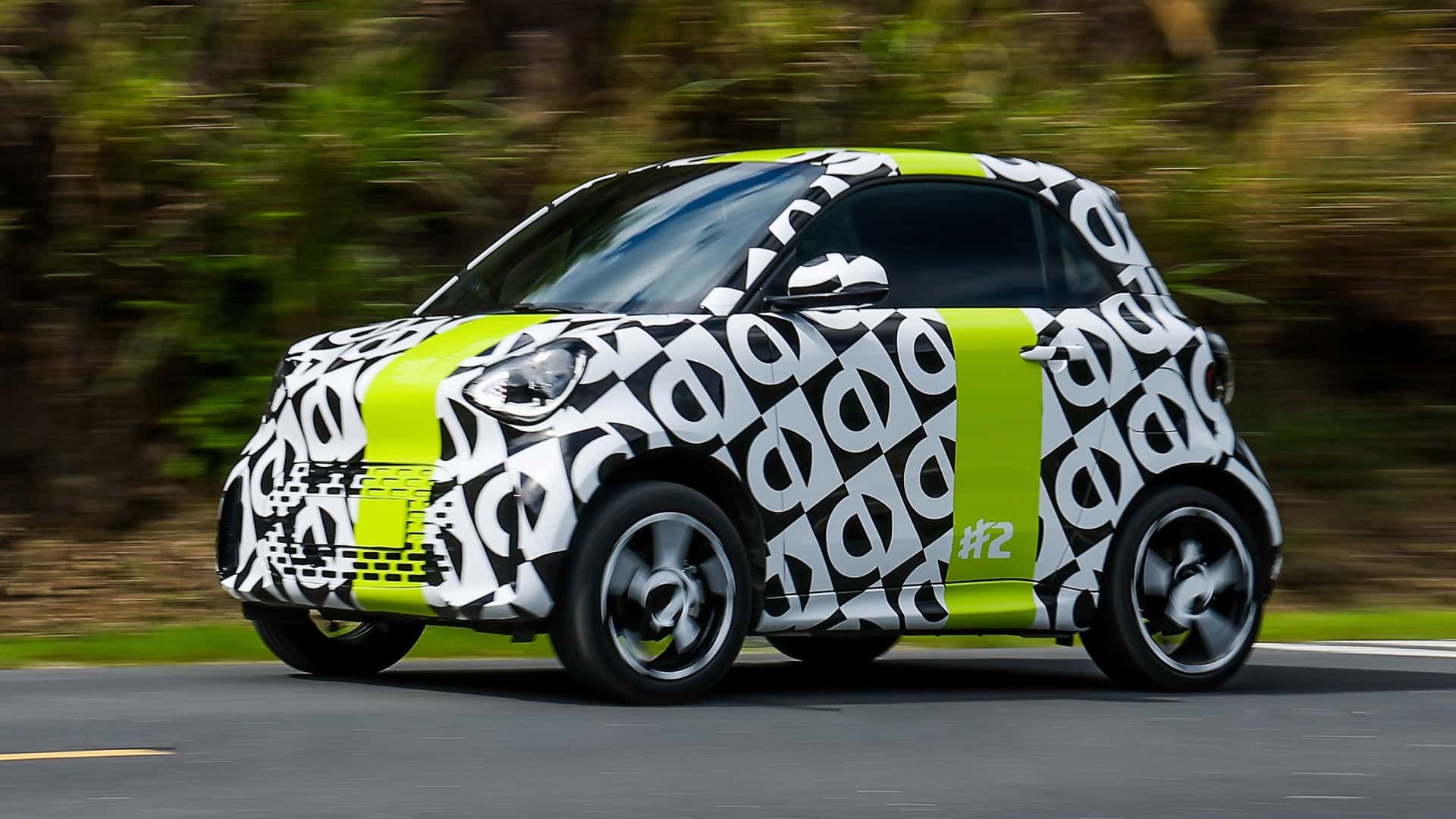
Smart didn’t just revive its city car. It rebuilt it from the ground up.
The brand released fresh images of the new #2, a compact EV that proves the concept phase is over. We are looking at a functional prototype now. The final production version is set to debut at the 2026 Paris Auto Show this October.
This isn’t your grandfather’s Smart ForTwo. The original was a combustion-engine microcar with a distinct Mercedes flavor. This new #2 is a dedicated electric vehicle on a bespoke platform. The goal? Maximize space in a package so small it can dodge traffic with surgical precision.
The Seat That Folds In Half
The interior is where the #2 gets clever. Or maybe just weird.
Smart has installed the window switches and door lock buttons on the upper edge of the center console. Why there? Because that central section folds down. It’s a physical manipulator, featuring a loop for easy access.
It’s safe to say the central section folds down to merge with the two side seats.
Here’s the catch. It does not turn the Smart #2 into a three-seater. Do not expect to squeeze your kids in there. It remains a strict two-seater. The middle part collapses to form a continuous, albeit narrow, bench.
Why bother with a bench seat in a 10-foot-long car?
Versatility. It creates the illusion of a wider cabin. More importantly, it makes exiting through the opposite door much easier when you are parked in a tight urban spot. You aren’t wedged in anymore. You slide out.
The dashboard follows this curvaceous logic, shaped like an “S” with turbine-style vents that nod to Mercedes heritage. But don’t worry about screen overload. There are no supersized monitors here. The interface will likely be minimal, balancing tech with physical usability—though physical buttons remain sparse.
Built For The Concrete Jungle
Under the floor lies a 35.7-kWh lithium-ion battery.
The estimated range sits at 186 miles on the WLTP cycle. That’s roughly 300 kilometers. It’s not a cross-country runner. It’s a commuter runabout. But the charging speed is where it gets interesting.
Smart claims the #2 can go from 10% to 80% in less than 20 minutes. That’s fast. It means a quick stop at a café is enough to refill the tank for most daily tasks.
The platform shift matters more than the battery size. The old EQ ForTwo shared bones with gas models. The #2 uses a dedicated EV architecture. Engineers stretched the wheelbase and shortened the overhangs as much as possible.
Result?
A turning circle of just 22.2 feet (6.95 meters).
Try parking a mid-size sedan at that radius. You’ll likely need a parallel parking permit. This car can reverse into a space that barely fits its own length.
Safety And Suspension Surprises
In the segment dominated by simple MacPherson struts, Smart made a bold choice. The #2 features a multi-link independent rear suspension. It’s an expensive setup for a budget car, but it translates to better ride comfort and handling precision. You feel it on rough city streets.
Safety is another pillar. The original Smart made headlines with its Tridion safety cell in the 1990s. The #2 takes that concept to the next level. Mercedes-AMG High Performance Vehicles, which now oversees the brand, hasn’t released full technical details yet. They are saving those for the official launch.
Where To Buy And How Much
The #2 will be sold exclusively.
And yes, it is built exclusively in China. Smart’s production lineup, from the compact #1 to the upcoming #2, rolls off Chinese assembly lines. This shift away from the French plant at Hambach (which now belongs to Ineos) signals a total pivot in manufacturing strategy.
Sales begin next year. But the real question is price.
Estimates suggest a starting point around €20,000.
That puts the Smart #2 directly in the crosshairs of the reborn Renault Twingo EV and the second-generation Dacia Spring. These are affordable EVs. They are larger than the Smart. They offer more room.
The Smart #2 offers something else entirely.
It offers a footprint smaller than most city bicycles. It offers a folding center that tricks the eye. It offers a driving experience that prioritizes agility over volume.
Will buyers trade extra cargo space for the ability to parallel park in a gap that looks like a drawing error?
That’s the gamble.
The #2 arrives in Paris this October. The world will get to see if the formula still works when the masks come off. Until then, we have only a prototype. And a promise of agility.
The urban jungle is about to get a lot more maneuverable. Whether it gets the market share to survive is another story.


