You might assume the 1968 Ford Mustang Fastback from Bullitt and the original 1984 Plymouth Voyager have zero in common. One is a high-octane film prop. The other is the utilitarian ancestor of the suburban family hauler. Yet both sit on the same exclusive list: the National Historic Vehicle Register.
It sounds like a marketing gimmick, but it is an official designation managed by the Historic Vehicle Association in partnership with the U.S. Department of the Interior. Established in 2013, the registry’s mandate is specific: preserve and celebrate the stories of America’s most significant vehicles by archiving them within the Library of Congress.
What qualifies a car for the National Historic Vehicle Register?
Getting on this list isn’t about mileage or condition. It is about cultural impact. Think about it. Which vehicle defines a specific moment in time better than others?
The register currently holds just 24 entries. That scarcity is intentional. It elevates these machines from mere collectibles to historical artifacts. The goal is to recognize significant historic automobiles that shaped American society.
Where can you see these historic vehicles today?
For most enthusiasts, the National Historic Vehicle Register cars are invisible. They are privately owned. Unlike the National Register of Historic Places, which protects buildings, this registry does not impose strict preservation laws on owners. It offers recognition.
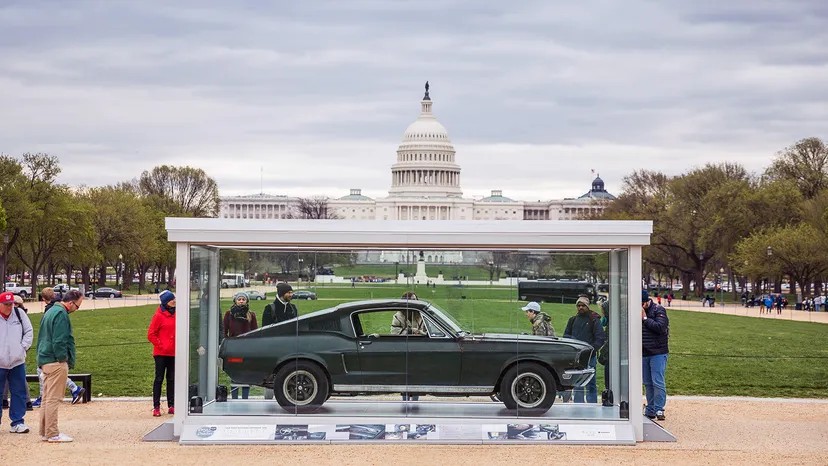
There is one exception: the annual “Cars at the Capital” exhibition. Held every April on the National Mall in Washington, D.C., this event is the primary way the public interacts with these icons.
During the 2018 showcase, visitors could walk among:
– The 1968 Ford Mustang GT driven by Steve McQueen in Bullitt
– The 1985 Ferrari 308 GTS (Modena Spyder) from Ferris Bueller’s Day Off
– The 1918 Cadillac U.S. 1257X
– The very first 1984 Plymouth Voyager
– A 1927 Ford Model T
Why private ownership matters for historic cars
The fact that these cars remain private property is a double-edged sword. On one hand, it ensures the owners have absolute discretion over display and restoration. On the other, it means you cannot simply drive to a museum and see them.
Most of the 24 registered vehicles are scattered across private collections or museum displays around the country. The National Historic Vehicle Register website tracks where these cars are currently on public view. If you miss the D.C. exhibition, you have to know exactly where to look.
How do you track these cars when they aren’t at the Capital?
Since the cars are not permanently stationed in one location, their visibility is sporadic. The Historic Vehicle Association relies on the owners to report when a vehicle is being exhibited. This creates a patchwork of access. You might catch the Bullitt Mustang in Los Angeles one year and in New York the next. Or it might disappear for a decade between private sales.
The registry serves as a database of significance, not a museum ticket. It answers the “why” behind a car’s survival. Why did this specific Mustang survive?
The Criteria for Immortality
You don’t just wake up one day and find your vintage Mustang on the National Historic Vehicle Register. There are exactly 24 cars in that collection right now, and getting a slot is harder than finding a clean ’69 Boss 302 in the wild. The Historic Vehicle Association (HVA) runs a tight ship. To even be considered, a machine needs an undeniable link to U.S. history. It’s not enough to be fast or pretty.
The vetting process looks for one of four specific markers of significance. First, the car must be tied to events that shaped automotive or American culture. Think landmark debuts or historical milestones. Second, it has to be connected to a notable figure. Did a president, inventor, or cultural icon drive it? Third, the engineering or design has to be distinctive. We’re talking about craftsmanship that pushed the envelope or aesthetics that defined an era. Finally, there’s the rarity factor. Is it the first of its kind? The last? Or just one of the few survivors that hasn’t rusted into oblivion?
Casey Maxon, a historian at the HVA, points out that timing matters too. Staffers look for anniversaries or current events that can spark public interest. It’s about creating buzz. But it’s not a solo decision. The staff works with a network of academics, museum professionals, and restoration experts. Their input shapes the final list. The Library of Congress then archives the details, keeping the data accessible to anyone who wants to dig in.
This selectivity means that owning a specific model year isn’t a golden ticket. Ronald Reagan’s 1962 Willys Jeep CJ-6 made the cut. That doesn’t mean every other 1962 CJ-6 is automatically eligible. Provenance and specific history do the heavy lifting here.
The Price of Documentation
Once a vehicle is selected, the real work begins. And it’s expensive. Between five and ten cars join the register each year, but each one undergoes a forensic level of documentation. This isn’t just snapping some photos in a driveway. The HVA follows guidelines similar to the Historic American Engineering Record.
The process is exhaustive. You get extremely detailed photography. A written report traces the vehicle’s entire life, complete with historic images. Laser scans create scale drawings for archival accuracy. And yes, there’s a short documentary film produced for each entry. This usually happens at the HVA’s National Laboratory, though sometimes they travel to a location relevant to the car’s history.
Funding this is a major hurdle. The HVA partners with automotive industry sponsors, but big projects require additional fundraising. You can’t just submit a form and hope for the best. Currently, the register does not accept public submissions. So if you’re sitting on a barn-find gem and hoping for federal recognition, you’re out of luck. For now, the gatekeepers decide.
A Global Impact
The list is predominantly American, but it’s not exclusively so. The HVA looks for vehicles that impacted American culture, regardless of where they were built. That’s how you get a 1938 Maserati on the same roster as a Ford Model T. A 1954 Mercedes-Benz also holds a spot, proving that European engineering has left a mark on U.S. automotive consciousness.
And then there’s the pop culture wildcard. The 1985 Modena Spyder Ferrari from Ferris Bueller’s Day Off is on the register. It’s a reminder that cars aren’t just machines. They’re props in the movie of our collective memory.
Maxon notes that the HVA maintains a database of vehicles that meet the criteria but were passed over. The list is static, but the pool of eligible cars is deep. It’s a curated snapshot of what the establishment values at any given moment.
Why do we care so much about metal and rubber? Maybe because these machines are the only time capsules that actually move. They carry the scars, the modifications, and the stories of everyone who ever turned the key. The register preserves the facts. The owners keep the soul alive.
The gap between a car being driven and a car being archived is wide. Once it’s in the Library of Congress, it’s safe. But it’s also frozen. The debate over preservation versus use continues. Some say these cars should be on the road. Others argue they belong in climate-controlled silence, protected from the elements and the wear of daily life.
There’s no easy answer. The HVA chooses the ones that speak loudest to the past. The rest remain in driveways, garages, and salvage yards, waiting for a future that may never come.