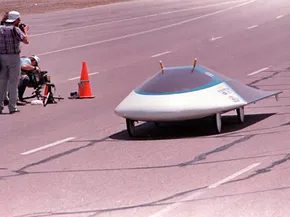
Gas was cheap in 1986. Less than a dollar a gallon. Cheaper than a soda in some places. Roger Smith, GM’s CEO, didn’t care. He wanted glory. He hired Paul MacCready and his ragtag team at AeroVironment to build a solar car in under a year. The goal? The World Solar Challenge. A brutal, 1,864-mile race across the Australian outback.
Solar wasn’t new. The ’70s energy crisis had made it a hot industry. Specialized labs were popping up everywhere. MacCready was the best in the business, but he flew planes. Exotic materials. Ultra-light frames. He had never built a road vehicle. The Australian heat alone was enough to melt lesser machines.
The Sunraycer won. It wasn’t close. But the victory was hollow. It exposed GM’s blind spot. They misunderstood the future. They built a trophy, not a product.
How GM Won the First World Solar Challenge
The idea started in GM’s Australian division. Smith heard the pitch. He didn’t question the timeline. He just demanded feasibility. MacCready said yes. Of course he did.
The design was a joint effort with Hughes Electronics. Test drives happened in Arizona by early October 1987. The car didn’t just run. It dominated. Four laps of a five-mile track. Top average speed: 35.227 mph. A new land speed record for solar vehicles.
The World Solar Challenge is no joke. It starts in Darwin. Ends in Adelaide. Public roads. Real traffic. Real rules. You drive from 8 a.m. to 5 p.m. Then you camp. You repeat this for days. Until 1999, the race happened every three years. Now it’s biennial.
Qualifying for that first race in ’87? GM took pole position. Fastest time. No surprise.
The race day limit is nine hours. The Sunraycer finished in 44 hours and 54 minutes. It was more than two days ahead of the second-place car. The Sunchaser. Built by Ford. The Ford took 67 hours and 32 minutes. Average speed for GM? 41.5 mph. For Ford? Slower. Much slower.
Reliability won the race. The car didn’t break. It didn’t overheat. It just kept going.
The Engineering Behind the Rolling Cockroach
It looks simple. Maybe too simple. A low-profile shell. A flat top.
The engineering was deliberate. Ruthless. Every gram mattered. Every surface area counted. The design prioritized one thing: efficiency. Not style. Not range in traffic. Pure, unadulterated aerodynamic efficiency under sunlight.
The name “Sunraycer” sounds heroic. The shape? Like a cockroach flattened by a boot. Functional. Ugly. Effective.
This wasn’t just a car. It was a statement. A statement that GM had the tech. The resources. The will.
Why did it matter? Because it proved solar could work. On a global stage. Against giants like Ford.
But winning a race isn’t the same as building a car people buy. The gap between those two concepts is where GM failed.
The Ghost of Solar Airplanes Past
MacCready didn’t start with cars. He started with wings.
-
The Gossamer Penguin. First solar-powered aircraft to fly. Human-powered hybrid. But solar? Yes.
-
The Solar Challenger. Bigger. Rigid. More power. It didn’t just hover. It crossed the English Channel. 163 miles. From Paris to England. Cruising altitude: 11,000 feet. Powered only by the sun.
If you could fly across the channel on sunlight, why not drive across Australia? The logic was sound. The execution was flawless. The commercial application? Non-existent.
GM had the tech. They had the win. They had the story.
They didn’t have the strategy.
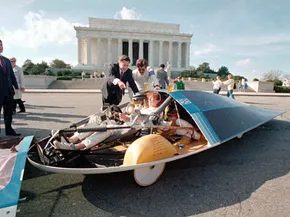

The Sunraycer looks like a squashed bullet mated with a cockroach. Long, sleek, and strange. It is a car that defies standard aesthetics because it was built for a single purpose: solar power. The skin of the vehicle is covered in more than 7,000 solar cells. That is about 90 square feet (8.4 square meters) of photovoltaic skin. These cells charge a massive silver-cell battery pack located behind the driver’s compartment.
The driver sits low. Almost like in a Formula One or Indy Car. The entire vehicle, minus the human inside, weighs less than 400 pounds (181.4 kilograms). It is light. Fragile, even.
Alongside the main battery, there is a smaller silver-zinc unit. Its job is specific. It handles acceleration past slow traffic or up hills. Both batteries feed a lightweight direct-drive electric motor. This motor spins the rear wheels. It weighs just 8.1 pounds (3.7 kilograms) and produces two horsepower. Two. Horsepower.
Aerodynamics and Heat Management
Drag is the enemy of solar cars. The Sunraycer’s design slung back everything to eliminate it. Engineers calculated every curve. The result? A drag coefficient (Cd) of .125. That is incredibly low. For context, a McLaren F1 sits at .32 Cd. Most production cars rarely dip below .30 Cd. The GM EV-1, which we will discuss shortly, also had a very low drag coefficient, but the Sunraycer set the bar early.
The solar cells themselves are similar to those found on satellites. Peter MacCready used his aerospace engineering background to design the cockpit. It had to be comfortable enough for a driver to sit in for hours. The Australian Outback is hot. There was no air conditioning. No outside ventilation. Just a sealed box.
So, engineers applied a thin gold film over the cockpit. It blocked 90 percent of visible light. More importantly, it blocked 98 percent of the Sun’s infrared radiation. The driver stayed cool. The car stayed light.
The Sunraycer and the EV-1: A Precursor
The Sunraycer is widely viewed as the predecessor prototype to the failed EV-1 program. In 1987, solar-powered electric vehicles for mass transportation were considered gimmicky. Most people did not have alternate fuels on their minds.
Fast forward 22 years to 2009. Peak oil prices are inevitable. The U.S. auto manufacturers are in economic struggles. It becomes obvious that advancing alternative fuel vehicles like the EV-1 would have helped. But the blame does not fall squarely on GM.
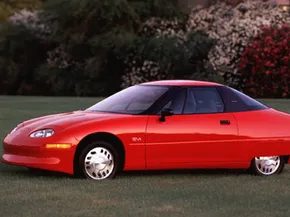
The EV-1 ran on lead-acid batteries. The same type found under the hood of your average gasoline car. They did not have much range. GM stated the EV-1 had a range of around 120 miles (193.1 kilometers). Later, they bumped this to 160 miles (257.5 kilometers) with nickel-metal hydride batteries. But many drivers claimed the actual range was far less. Especially when using accessories. Air conditioner. Heater. Headlights. All of them drained the battery faster.
Charging Infrastructure and Costs
Recharge stations were not readily available. The EV-1 could recharge in about two hours under ideal conditions. But perhaps the biggest problem was the cost.
For about $38,000, drivers could lease the EV-1. Servicing was handled through Saturn dealerships. Herein lies the major snafu. The EV-1 cost GM roughly $80,000 per vehicle. The Detroit manufacturer bled money with each sale.
GM sought out and destroyed nearly all of the EV-1s toward the end of the program. This is documented in the film Who Killed the Electric Car?. In the end, GM lost somewhere in the neighborhood of $2 billion on the EV-1 program. Who would have thought one vehicle program could cost a company so much?
While the EV-1 may have failed financially, the Sunraycer’s legacy lives on.
An Expensive Used Car
In October 2008, a Canadian man reportedly sold a 1998 GM EV-1 for $465,000 Canadian dollars. That is roughly $360,000 U.S. dollars. The car was originally purchased by the seller’s grandfather. It had been stored in a garage for four years leading up to the sale. Even though the car had 88,545 miles (142,499.4 kilometers) on the odometer, it fetched nearly a half a million dollars.
GM destroyed nearly every EV-1. The ones that have survived are either in museums or university research centers.
Legacy of the GM Sunraycer
The transition from the Sunraycer to the EV-1 highlights a specific era in automotive history. It was a time of experimentation. Of high hopes and higher costs. The Sunraycer proved that solar could work. The EV-1 proved that infrastructure and economics were the real barriers.
What did the automotive industry learn from this? And what is in store for GM’s electric vehicle program now? The story continues.
“Considering the EV-1 cost GM roughly $80,000 per vehicle, the Detroit manufacturer bled money with each sale.”
From Desert Solar to ZEV Mandates
The momentum didn’t stop in 1987. GM leveraged the Sunraycer’s triumph to push solar tech further, leading the charge in 1990 with the first GM Sunrayce USA.
Thirty-two college teams raced an 1,800-mile gauntlet from Florida to Michigan. The top three finishers earned a ticket to the World Solar Challenge in Australia.
It was a proving ground. And the lessons learned directly shaped the next step.
The Birth of the Impact and the EV-1
Post-Sunrayce, GM pivoted hard. They developed the Impact concept vehicle.
This wasn’t just a science project. It was a strategic response to California’s Zero-emissions Vehicle (ZEV) mandate. The rule required major manufacturers to sell at least 2 percent of their fleet as zero-emission units.
The Impact evolved into the EV-1.
Designed as an electric sports car, the EV-1 was GM’s answer to regulatory pressure. The technology was sound. The execution? Flawed.
Rick Wagoner, GM’s current CEO, has been blunt about the outcome.
“I believe the termination of the EV-1 was the biggest mistake of my tenure.”
He regrets not doubling down on hybrid technology earlier. The EV-1 proved electric drivetrains could work. But the company mismanaged the rollout.
Fuel Crises and Market Shifts
The timeline matters.
In the years following the Sunraycer and the brief EV-1 era, fuel prices skyrocketed. Consumer taste shifted rapidly.
Buyers abandoned massive SUVs and trucks. They wanted smaller, gas-efficient sedans and compact cars. GM stared down a potential existential threat. The company faced the danger of permanent closure.
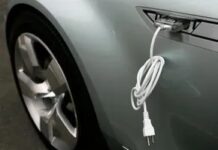
Enter the Chevy Volt.
Developed over several years as an extended-range electric vehicle, the Volt became GM’s potential lifeline. It could have saved the iconic brand.
Had GM transferred its EV-1 battery and motor technology into the Volt when they still had momentum, the story might be different.
Instead, GM lagged. They found themselves years behind fuel-efficient competitors like Honda and Toyota.
Now, with federal government money pumping into the struggling auto industry, the Volt is more than a car. It’s a last-ditch effort to stave off permanent foreclosure.
The Sunraycer’s Legacy
Today, the original GM Sunraycer sits quietly in the Smithsonian Museum of American History in Washington, D.C.
It stands as a testament to the innovative minds of the late 1980s. The vehicle proved solar energy could be a viable fuel alternative.
The path the Sunraycer laid through the Australian Outback over two decades ago still echoes.
Will it be the swan song of a proud American company? Or the turning point for a new generation of electric mobility?
Only time will tell.