



Internal combustion engines are messy. They choke the air with pollutants, strip the planet of non-renewable resources, and keep the U.S. economically tethered to nations we’d rather avoid. It’s an ugly dependency.
And yet.
They aren’t going anywhere. Not soon anyway.
You’ve heard the promises. Electric motors, hybrid powertrains, hydrogen fuel cells, even cars running on compressed air. The tech sector loves a savior narrative. But none of these alternatives are ready to replace the ICE just yet. Electric vehicles are the closest thing to a viable immediate future, sure. But they take hours to recharge, suffer from limited range, and you can’t just hop off the interstate and fill up in five minutes. Do you really want to be stranded in the middle of nowhere with a dead lithium-ion battery and no one within fifty miles who knows how to jump-start it?
Hybrids, like the Toyota Prius, are feasible. They’re popular. But they still contain an internal combustion engine. They don’t solve the problem; they just delay the inevitable reckoning.
Hydrogen fuel cells? They’re amazing in concept. They’ll be mainstream in twenty or thirty years. That’s when you’ll be shopping for false teeth. Compressed air cars? Let’s see you refuel one with a bicycle pump before we call it production-ready.
These technologies matter. Think tanks and manufacturers are grinding through the R&D. Your grandchildren’s commute will depend on them. Someday, one of them will break our fossil fuel addiction.
But we can’t wait thirty years. We need something that works now. Something practical for the next few years.
We need a better internal combustion engine.
The good news? They’re coming. Lighter. More fuel-efficient. Less polluting. If we can’t put the ICE out to pasture yet, we can at least make it behave while it gallops around public streets.
Enter the OPOC engine.
If that acronym doesn’t ring a bell, read it out loud. Opposed-Piston Opposed-Cylinder. It’s a mouthful. Just call it an OPOC. Ecomotor, a company actually building these for consumer vehicles, is taking this concept seriously. They’re aiming for market readiness long before hydrogen becomes the new cool.
Who’s backing this? Bill Gates. Yes, that Bill Gates. If anyone understands cutting-edge practical tech, it’s the Microsoft co-founder. His investment signals that this isn’t just a garage hobby. It’s a serious contender to revolutionize how we use gasoline.
So what is an OPOC? How does it differ from the V6 or inline-four rattling under your hood? To understand the innovation, you have to understand the standard.
How standard car engines work vs the OPOC difference
Most cars run on four or six cylinders. If you’ve got more than six, you’re driving a muscle car, and you probably aren’t here to discuss fuel efficiency.
A cylinder is exactly what it sounds like: a cylindrical hole in the engine block. Inside sits a piston, a moveable tube. Combine that piston with gasoline, air, and a spark, and you get explosive motive power. That’s the quick-and-dirty version.
In a traditional engine, each cylinder is capped. The gases trapped between the top of the piston and the cylinder head need to stay contained during combustion. To manage the flow of air and exhaust, manufacturers use two valves near the top of each cylinder. One is the intake valve, letting air and fuel in. The other is the exhaust valve, releasing the burnt gases after combustion.
These valves open and close in precise mechanical sync with the piston’s motion. Exhaust out. Fresh air in. Timing is everything.
The OPOC changes this dynamic. It doesn’t just tweak the valves; it reimagines the cylinder itself.
Why Two Pistons Are Better Than One
The four-stroke cycle is old news. Nineteenth-century engineers figured it out, borrowing heavily from steam engine logic. It works. It’s reliable. But it’s also heavy. And bulky. And if you’re chasing power-to-weight ratios, carrying around eight or twelve cylinders just to make linear motion circular feels like a tax on physics.
So what if we cut the cylinder count in half?
Not by making the cylinders bigger. By making them talk to each other.
Enter the opposed-piston engine.
Forget the traditional setup where a piston pushes against a cylinder head. In this arrangement, there is no head. No valves. No spark plugs nestled in the roof of the combustion chamber. Just a long tube with two pistons facing off from opposite ends. They move in sync. When they meet in the middle, they compress the air-fuel mix. When they pull apart, they create the vacuum for intake.
It sounds simple. It’s not.
How the Opposed-Piston Cycle Actually Works
Let’s break down the motion. You have Cylinder A and Cylinder B, but they’re actually one continuous bore. Piston 1 comes in from the left. Piston 2 comes in from the right.
As they approach each other, they close off the intake ports. The air-fuel mixture gets trapped. Squeezed. The pressure spikes. This is the compression phase, same as your Honda Civic’s inline-4. But then, instead of a spark plug firing, fuel is injected directly into the hot, compressed air.
Auto-ignition.
No spark needed. The heat of compression alone lights the fire. This is technically a Diesel cycle variant, even if you’re using gasoline. The explosion pushes both pistons outward simultaneously. They hit the exhaust ports. Burned gases escape. The cycle resets.
No cylinder head means no head gasket to fail. No valves to break. Fewer moving parts to wear out.
The geometry is brutal. The pistons have to stay perfectly synchronized. If one lags by a millimeter, they don’t just miss the compression peak. They might collide. Metal on metal. At thousands of RPMs. That’s not a repair. That’s a scrapyard run.
The Crankshaft Connection: It’s Not What You Think
Here’s the twist that breaks most engine designs. In a standard V6 or flat-four, the pistons connect to a single crankshaft. In a true opposed-piston engine, there are two crankshafts.
One drives the left piston. The other drives the right.
They’re linked by timing gears or chains, ensuring that when Piston 1 goes down, Piston 2 goes up. The rotation cancels out vibration naturally. No counterweights needed. The engine is inherently balanced.
This setup was popular in World War II aircraft engines. The Junkers Jumo 205 powered everything from bombers to submarines. Why? Because it was compact. It had a low profile, fitting easily into tight fuselages. And it was rugged. When you strip away the cylinder head, you remove the biggest source of heat soak and failure in an internal combustion engine.
But it also lacks flexibility.
Why We Abandoned It (And Why We’re Coming Back)
Opposed-piston engines have a fatal flaw in the consumer market: emissions and fuel flexibility.
Because the intake and exhaust ports are opened and closed by the pistons themselves, scavenging is tricky. You can’t control the valve timing independently. You can’t vary the overlap easily. This means tuning for clean emissions is a nightmare. Modern regulations demand precise control over when gases enter and leave the chamber. Port timing doesn’t give you that granularity.
So we switched to camshafts. We accepted the complexity of valves, heads, and timing belts for the sake of compliance.
But the industry is shifting.
Modern manufacturing tolerances have improved drastically. Computer-controlled injection systems can manage the auto-ignition process with micron-level precision. And the demand for compact, high-output powerplants in hybrid systems and electric-hybrid range extenders is bringing the opposed-piston design back from the dead.
Companies like Velozity Motors are building these engines today. They’re targeting hybrid vehicles where the engine doesn’t need to rev high, but needs to produce maximum torque with minimum size.
Is it ready for your daily driver? Maybe not yet. The oil consumption can be high. The lubrication paths
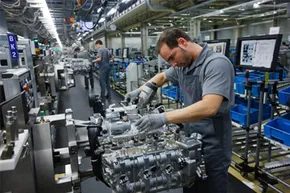

The Mechanics of the Ecomotors OPOC Design
Standard engines rely on pistons moving in parallel. One cylinder, one piston, straight down the line. Opposed piston engines flip that script. They put two pistons in a single cylinder. They face each other. They don’t crash. That is the whole point.
Ecomotors built this specific setup for DARPA. Military applications first. That makes sense given the rugged requirements. The geometry is wild. The crankshaft runs through the center of the cylinder. Perpendicular to the bore. Both pistons drive that same crankshaft as they move in opposite directions.
Think about the stroke length. Each piston only travels half the distance of a piston in a standard four-stroke engine. Less distance means less friction. Less friction means better fuel economy. And the exhaust? It pools in the center. No need to cap off the ends of the cylinder just to keep fumes from leaking before they are ready to exit.
It sounds like a dream. It is a two-stroke engine. But not the dirty, oil-burning two-strokes of the past. This is a clean-burning beast.
Why the Ecomotors OPOC Engine Has High Power Density
The magic is in the interlacing. Each piston is actually split into two parts. They move inside one another. Opposite directions.
Here is how the cycle works. One end of the pistons closes together. That creates compression. The fuel and air mix gets squeezed. At the exact same time, the other ends of the pistons move apart. That creates a vacuum. Air rushes in. Intake and compression happen simultaneously.
Two strokes. Intake. Compression. Ignition. Exhaust. Done.
Conventional engines need four strokes to do the same job. The OPOC does it in two. Because the two pistons in one cylinder do the work of two separate cylinders in a normal engine, they apply double the motion to the crankshaft for the same amount of space.
That equals high power density. More power per pound of engine mass. For military vehicles or drones, weight is everything. This design delivers.
How the Modular Design Reduces Moving Parts
Simplicity is the real killer feature here. Standard internal combustion engines are mechanical nightmares. You have camshafts. Rocker arms. Lifters. Valves. A complex, precisely timed dance to keep intake and exhaust valves open only when they should be. Never at the same time. Always at the right millisecond.
Ecomotors eliminated all that.
There are no valves.
The “valves” are just ports on the side of the cylinder. The pistons slide over them. Covering them. Uncovering them. That is it. No camshafts. No timing belts. No complex linkage systems.
The part count dropped from 385 to 62.
That is a massive reduction. Fewer parts mean fewer things to break. Fewer things to service. The engine is mechanically simpler. It is more robust.
And it is modular. You can stack them. One OPOC cylinder is technically a two-cylinder engine in power terms. Add another. Now you have the equivalent of a four-cylinder engine. Add a third. Six-cylinder power. Just keep hooking cylinders together.
Is it the engine of the future? Probably. Until nuclear fuel cells become viable for consumer use. The efficiency gains are too good to ignore. The simplicity is undeniable.


