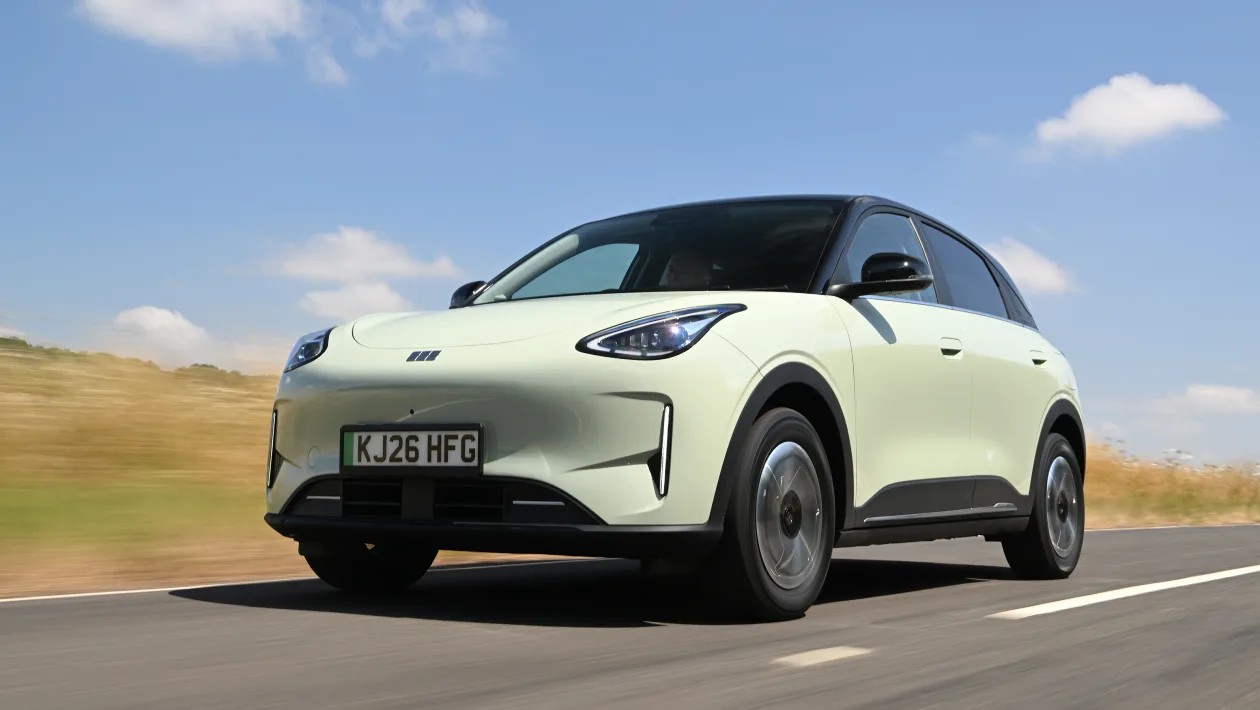
The Geely EX2 is respectable. It drives fine. The tech is competent. But it is also utterly forgettable.
If you walk into a dealership next August, this might look like a decent bet. The entry-level model starts at £20,990 when order books open. That makes it one of the cheapest electric options in the UK. On paper, it undercuts the heavy hitters.
In reality? You are paying for mediocrity.
This car is the UK-bound version of China’s best-selling vehicle last year. Nearly 500,000 of these boxes moved off lots there. The Chinese market loves the “Geome Xingyuan” because it costs less than £7,000 equivalent. Here? Expect to pay three times that.
Range anxiety starts at the showroom door
Let’s talk about the elephant in the room. Range.
The base “Pro” model ships with a tiny 35.4kwh battery. That gives you a claimed 156 miles. For context, that is city car territory. Think Renault Twingo or Honda N-Box, not modern EV standards.
Rivals offer nearly 200 miles for the same cash.
- The Renault 5 offers ~200 miles starting just above this price.
- The Fiat Grande Panda matches the range for less money.
- The Citroen e-C3 delivers similar efficiency without the premium tag.
Most buyers won’t pick the base model though. They want the Max or Ultra trim. Even then, you’re only climbing to 214 miles on the bigger 47.1 kWh pack. Compare that to the Renault 5 (up to 252 miles), Kia EV2 (roughly 280 miles), or Cupra Raval. Geely is playing catch-up before the race even started.
“If the EX2 can’t entice Buyers with style, a staggering price, or competitive range, it has to rely on value.”
It does that part. And it’s annoyingly good at it.
Features overload but plastic overload
Inside the EX2, the packaging lies to you. This isn’t a tin can. Geely stacked the deck.
Every model comes with:
– A large 14.6-inch central touchscreen
– Wireless Apple CarPlay and Android Auto
– An 8.8-inch digital driver’s display
– Power-adjustable front seats wrapped in faux leather
– Adaptive cruise control and blind-spot monitoring
It sounds like a premium spec sheet. It feels solidly built, too. But touch it, and you hit the truth. It is all hard black plastic. Glossy piano black surfaces that collect dust like magnets. Thin synthetic leather that whispers “budget.”
Compare this to the Kia EV2 or the nostalgic revival of the Renault 5. They use fabrics. They create warmth. The EX2 creates a vacuum where character should be.
However, practicality is undeniable. This small hatchback hides 36 distinct storage cubbies. Yes, 36. Including a drawer-style glove box big enough to store the actual charging cable. Add a 25-litre hidden compartment under the rear seat, and the logic becomes clear: they can’t compete on range, so they compete on cubby space.
A cabin of contradictions
Space is where Geely punches above its weight. The EX2 stretches past 4.1 meters long. That extra few centimeters compared to the Renault 5 transforms the rear cabin. Six-foot-tall adults don’t just fit; they breathe. Legroom is generous. Headroom is ample.
The boot is 375 litres. Small compared to a VW Golf (412 litres), but significantly better than the Renault 5’s cramped 300 litres. Fold the seats down, and you unlock 1,320 liters of cargo area. More than the Golf. That’s impressive engineering, if the aesthetics are dull.
Technology wise, the screens are bright and sharp. Menu loading is swift. Icons are large and easy to tap while driving. But there are too many nested sub-menus to toggle basic settings. It’s typical Chinese EV software: functional but labyrinthine.
Worse is the digital driver’s display. Why is the range info crammed into tiny text off to the side? Why bury the speed in the corner? The center of that screen is dominated by a graphic of your car and surrounding sensors. It looks nice. It does nothing for utility.
Driving dynamics: Tuned by Lotus, but restrained
Lotus handles the chassis tuning for the European market. You’d expect drama. You might hope for excitement. You get none of it.
The ride is undulating. The suspension never fully settles, even on smooth roads. Potholes are handled decently enough. Body roll is controlled. Steering has some weight. It drives safely.
It doesn’t drive well.
And the powertrain holds it back.
- Base Model: 80bhp. 0-62 mph in 14+ seconds.
- Upgraded Models: 114bhp. 0-60 in 11.5 seconds.
11.5 seconds for 60 mph in 2026 feels sluggish. Overtaking requires planning weeks in advance. Motorway merges are a panic-inducing affair. The lane-keeping assist adds to the frustration, snatching the wheel violently if you drift from the center. Driver attention alerts blink repeatedly. It is exhausting.
The verdict: Safe, smart, soulless
Efficiency is where the Geely EX2 finds grace. We averaged 4.6 miles per kWh over mixed driving. At that rate, you can hit the claimed 214-mile range. Real-world viability? Acceptable for town commuting. Lethal for cross-country journeys without anxiety.
Ultimately, this car suffers from a personality crisis.
It’s not fast. It doesn’t look special. It feels cheap in key places, yet expensive in parts count. It tries to be everything and succeeds at being adequate. In a market dominated by the charming retro-futurism of the Fiat 500 or the driver-focused zest of the Cupra Raval, the Geely EX2 feels like a white appliance.
Functional? Yes.
Essential? Debatable.
With competitors closing the gap on price and range, this forgettable hatchback may find itself squeezed out before the second year begins. Unless Geely adds real charm next year. But for now? You can buy it. Just don’t expect to fall in love with it.
Spec Sheet: Geely EX2 Ultra
Price: £25,490
Battery: 47.1kwh usable capacity
Motor: Rear-mounted e-motor, 114bhp / 150Nm torque
Range: Up to 214 miles
0-62 mph: 11.5 seconds
Boot Space: 375L (1,320L with rear seats folded)
Charging: DC up to 80kW
On Sale: Late August