


Lowering tire pressure isn’t just a trick for rock crawlers anymore. It’s the core function of a Central Tire Inflation System, or CTIS. By letting you adjust air pressure on the fly, these systems radically change how a vehicle handles different surfaces. You get a bigger contact patch on soft ground. That means easier maneuverability. It also reduces surface damage. This matters on construction sites. It matters in agricultural fields.
The logic is simple physics. Less pressure equals more grip. But CTIS adds a layer of automation that manual valve stems can’t match. It maintains pressure during slow leaks. If you hit a puncture, the system inflates automatically to keep you moving. You stay at your selected baseline.
Two companies dominate this niche. Dana Corporation in the US. Syegon, a French division of GIAT, in Europe. Dana splits its hardware into two distinct lines. The military-grade CTIS. And the Tire Pressure Control System (TPCS) for heavy commercial machinery. Both rely on the same fundamental architecture.
The Anatomy of a CTIS
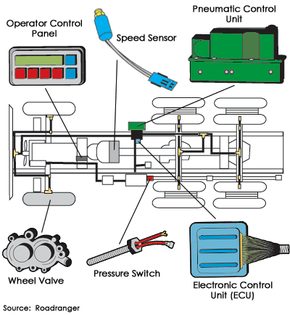
The system is a network of valves, sensors, and controllers. It starts at the wheel. A wheel valve sits at each wheel end. In dual-wheel setups, these valves typically connect only to the outer tire. This balances pressure between the two tires. It also isolates the tire from the system when idle. That relieves stress on the seals. Extends their life.
The brain of the operation is an electronic control unit (ECU). You’ll find it mounted behind the passenger seat usually. It processes driver commands. It monitors every signal in the loop. The ECU checks tire pressure every ten minutes. It ensures the selected pressure holds steady.
From there, the ECU talks to a pneumatic control unit. This component directly controls the wheel valves and air distribution. It has a built-in sensor. That sensor feeds pressure data back to the ECU. It’s a closed loop.
Driver Interface and Automation
The operator control panel lives on the dash. It’s your interface. You select modes to match current terrain. The panel shows current pressures. It displays selected modes. It indicates system status. When you turn a dial or press a button, the signal travels from the panel to the ECU. Then to the pneumatic control unit. Finally, to the wheel valves.
Speed plays a role too. A speed sensor feeds vehicle velocity to the ECU. If you’re cruising on a highway, high pressure is better for tire integrity. The system detects sustained high speed. It automatically inflates tires to a safer level. You don’t have to think about it.
The air source is shared. It comes from the same compressor that feeds the brake system. A pressure switch manages this shared resource. It gives the brakes priority. The CTIS won’t steal air from the supply tank until the brakes are fully charged. Safety first. The brakes get what they need. The tires get the rest.
This setup works well until the compressor runs dry. Or the lines clog. We’ll look at the failure modes and maintenance headaches in the next section.

The Mechanics of Pressure
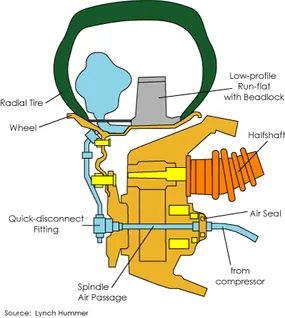
The ECU calls the shots. It sends a signal to the pneumatic control unit to read the current tire pressure. If the driver has set a target, the system adjusts accordingly. It either inflates or deflates.
Inflation requires a sequence. First, the system checks brake pressure reserves. Are they where they should be? If yes, it applies slight pressure to the wheel valve. Air flows in.
Overinflation is handled differently. The system applies a slight vacuum to the wheel valve. It sucks the excess air out. Once the pneumatic control unit reads the correct pressure, the valve closes. Done.
The air pathway is straightforward. Tubing runs from the vehicle’s air compressor through the wheel hub. From there, it connects to the tire valve. There is a “quick disconnect fitting” in the mix. This allows the tire to be separated from the Central Tire Inflation System (CTIS) for removal or servicing.
The diagram also highlights the Hummer’s run-flat feature. This allows the tire to support the vehicle even when it holds no air.
Early Adopters
GM didn’t wait around. By 1984, they offered CTIS on CUCV Blazers and pickups.
CUCV stands for Commercial Utility Cargo Vehicle. These trucks entered U.S. military service in the mid-1980s. They are essentially full-size Chevrolet Blazers and pickups with special equipment added for military applications.
Why CTIS? The military needed versatility. Sand, mud, snow, rock. One pressure setting doesn’t cover it all. The system allowed soldiers to adjust on the fly. It wasn’t just about comfort. It was about mobility and survival.
The technology wasn’t new to engineers, but putting it in a consumer-adjacent vehicle was a leap. The CUCV program proved the concept worked in harsh environments. It set the stage for later civilian applications.
The quick disconnect fitting is a critical detail. In the field, you might need to swap a tire quickly. Or service it without draining the entire system. The fitting makes that possible.
Run-flat capability adds another layer. If a tire goes down, you aren’t stranded immediately. You can keep moving. This is vital in combat zones or remote areas.
GM’s early adoption gave them a head start. Other manufacturers watched and learned. The technology spread. Today, CTIS is more common. But it started with these military-grade trucks.
The system’s reliability is key. It has to work every time. No exceptions. The ECU logic is robust. It checks conditions before acting. This prevents damage to the brake system or the tires.
It’s a complex system. But it simplifies driving in extreme conditions. You don’t have to stop and adjust manually. The car does it for you.
This efficiency is why CTIS persists. It’s not just a gimmick. It’s a functional necessity in certain applications.
The history of CTIS is tied to military needs. But the technology benefits everyone who drives off-road. It’s a prime example of military tech trickling down.
The CUCV program was a proving ground. It tested the limits. It refined the components. And it paved the way for modern automotive innovations.
So, next time you see a Hummer or a similar off-road vehicle, remember the roots. It’s


