
You checked the mirrors. You matched the hitch. The brake lights synced up perfectly with the trailer. You loaded the gear, confident the rig was ready, and merged onto the highway. Then it happened. A steady speed turned into a nightmare as the trailer behind you began to bounce and sway with increasing aggression. You pulled over, heart pounding, trying to piece together what went wrong. The cargo weight feels heavy. Too heavy? Maybe. But if the suspension is too rigid, the wheels leave the pavement entirely when they hit a bump. That’s when stability vanishes. The solution often lies in an ancient technology that’s making a modern comeback: leaf springs.
Why Suspension Matters More Than You Think
When a towed vehicle rocks and sways, it’s rarely just about the weight itself. It’s about how that weight interacts with the road. If your truck’s suspension is too stiff, it acts like a rigid plank. One minor imperfection in the asphalt sends the trailer into a oscillation loop. A good suspension system keeps the tires planted. It absorbs the shocks instead of transmitting them. For many heavy-duty towers, leaf springs are the go-to stabilization method. They keep the cargo grounded and the ride predictable.
The History You Didn’t Ask For
Leaf springs aren’t new. They’ve been around for centuries. In fact, Leonardo da Vinci sketched them into his designs for self-propelled carriages long before the internal combustion engine existed. They are one of the earliest forms of suspension technology. Simple. Effective. Relentless. But how do they actually work? Are there different types? And can you just bolt them on?
Choosing Leaf Springs
Not all leaf springs are created equal. Selecting the right ones depends on your truck’s payload, your trailer’s weight, and the type of terrain you navigate. Multi-leaf designs offer more cushioning, while single-leaf springs provide a tighter, sportier ride. Some towers opt for parabolic designs, which reduce weight and friction. The key is matching the spring’s rating to your actual load, not just your truck’s maximum towing capacity. Overloading a leaf spring system leads to sagging, poor handling, and yes—more swaying.
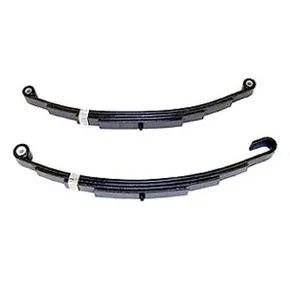

You look at a leaf spring and think, “That’s it?” No electronics. No complex geometry. Just a curved strip of steel.
It’s effective, though. That’s the point.
These springs are the unsung heroes of the towing world. They attach to the trailer frame and sit right above (or below) the axle. The curve? That’s where the magic happens. It stores energy when you hit a bump and releases it as the wheel returns to the road. Simple physics. Heavy-duty application.
The Anatomy of Steel
Not all leaf springs are created equal. If you’re towing a light camper, you might get away with a monoleaf spring. It’s just one thick plate of spring steel. Tapered in the middle, thin at the edges. Cheap. Light. But don’t expect it to handle much more than a weekend getaway with a small load.
Heavy haulers? You’re looking at multileaf springs.
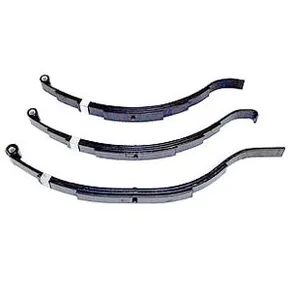
Stack them up. Different lengths. The shortest leaf goes at the bottom. The longest at the top. This creates that classic semi-elliptical shape. More leaves mean more strength. More leaves mean better suspension for heavier loads. It’s a simple trade-off: weight for durability.
Eye Contact
How does it attach? Look at the ends.
Double-eye leaf springs are the standard for most trailers. The longest leaf has both ends curved into a circle. These “eyes” have holes in them. You bolt them directly to the bottom of the trailer frame. Secure. Solid.
But sometimes, you need variety.
Open-eye leaf springs have only one circular end. The other side? It varies. It might end in a hook. Or it might be a flat end. This flexibility matters when your trailer’s frame geometry doesn’t match a standard double-eye mount. You’re adapting the spring to the chassis, not the other way around.
Why Installation Matters
Get it wrong, and your trailer will wander. Or worse, the axle will shift under load. The spring isn’t just a shock absorber; it’s a locator. It keeps the axle in the right place relative to the frame.
Proper installation is non-negotiable. You need the right bolts. The right torque. The right sequence.
We’ll get into the step-by-step process next. But for now, understand this: the spring does the work. You just have to make sure it’s attached correctly.
Installing Leaf Springs
The job starts with safety. Jack up the trailer. Support it with stands. Never work under a vehicle held up by a jack alone. Gravity doesn’t care about your schedule.
Remove the old springs. This usually means dealing with U-bolts. They’re corroded. They’re tight. Use penetrating oil. Give it time. Then, use a breaker bar. Force breaks rust. Patience breaks stubborn bolts.
Once the old leaves are out, inspect the hangers. Are they bent? Cracked? If the mounting points are damaged, the new spring won’t matter. It’ll just break the same way.
Clean the surfaces. Rust is the enemy of proper fit. A little sanding goes a long way.
Now, the new spring.
Slide it into place.
Securing the Axle with U-Bolts
With the wheel off, the real mechanical work begins. You are looking at the axle flanked by those metal hangers—little extended brackets with holes dangling from the trailer frame. This is where the leaf spring lives. Specifically, you line up the eyes of the spring with the holes in these hangers and bolt them in. If you’re dealing with a double-eye spring, one of those hangers will already have a shackle link attached. It’s a simple mechanical handshake, but it’s the foundation of your suspension.
Once the spring is anchored to the frame via those hangers, you need to lock it down to the axle itself. This is where U-bolts come into play. These are the heavy-duty, horseshoe-shaped rods that wrap around the axle. Depending on your setup, you’ll either be overslung (springs over the axle) or underslung (springs under the axle). The U-bolts don’t care; they just need to clench the axle tight against a metal plate that rests directly on the leaf spring stack. The goal here is physics: keep the springs flush against the axle. If they aren’t tight, the weight of your cargo will make them shift, shimmy, and eventually fail. You want rigidity, not play.
Inspecting for Wear Before You Go
Don’t just bolt it on and pray. A cracked or worn leaf spring is a ticking time bomb for your trailer and whatever you’re hauling. When you’re pulling the old parts out, take a second to look at the shackle links. Wear is inevitable, but there’s a right way and a wrong way for it to happen. If you see a round ring of wear that matches the contour of the nut, you’re probably still in the clear. If that hole stretches into an oval? Replace it immediately. Oval wear means the pin is bouncing around, eating up metal, and loosening the entire suspension geometry.
Proper maintenance here isn’t about vanity. It’s about keeping the tires planted and the cargo from sliding off the back of the trailer at 60 mph. Check the hardware. Check the eyes. Check the shackles. If it looks worn, swap it out.
Sources
- Eastern Marine Online. “Trailer leaf springs.” (Sept. 15, 2008) http://www.easternmarine.com/em_store/tech_info/leafspring_tech_info.html
- eTrailer.com. “Trailer leaf spring replacement demonstration.” (Sept 22, 2008) http://www.etrailer.com/tv-demo_trailer_leaf_springs.aspx
- Encyclopedia Britannica. “Spring.” Encyclopedia Britannica Online. 2008. (Sept. 15, 2008) http://search.eb.com.proxygsu-dep1.galileo.usg.edu/eb/article-9069244
- McNulty, Kevin. “Leaf spring basics.” Petersen’s 4Wheel & Off-Road Magazine. (Sept. 15, 2008) http://4wheeloffroad.automotive.com/85945/131-0809-leaf-spring-basics/index.html
- Spring Works. “Leaf spring FAQs.” (Sept. 17, 2008) http://www.springworks.com/faq.html