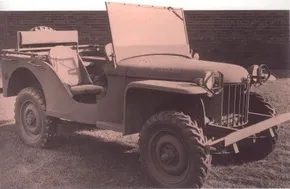
By late 1941, the blueprint for the iconic military jeep was solidifying. But the origin story is less about a collective effort and more about a single company that moved faster than the rest. American Bantam was the only automaker capable of delivering a running prototype within the Army’s absurd 49-day deadline. The secret? Karl Probst. He was the engineer working around the clock to get the Bantam Pilot ready.
While Probst was turning wrenches, the Army made a move that would define the next phase of the development. They ordered Bantam to build the remaining 69 vehicles from the initial bid. This order included eight units with four-wheel steering. The Army did this without ever seeing the finished prototype.
This pre-emptive strike had two immediate effects. First, it locked in the silhouette of the original jeep. This happened before Willys or Ford could even show their own designs. Second, it forced the other giants to accelerate. If Willys and Ford wanted a piece of the contract, they had to start building pilots immediately or be left behind entirely.
The Blueprint Heist
The Army Quartermaster Corps had a different problem to solve: diversification. They didn’t want to rely on a single supplier for the war effort. So, they handed copies of Probst’s blueprints to Willys and Ford. This happened despite vehement protests from American Bantam.
The Army’s justification was simple. They believed the design now belonged to the government.
Bantam’s anger was justified. But the urgency of the war effort left no room for corporate niceties. Willys and Ford received the drawings and skipped the hard part. They didn’t have to reinvent the wheel. They didn’t have to solve the basic chassis geometry. This sharing of technical data cut out massive amounts of legwork for the rivals. It also erased Bantam’s advanced development advantage.
The Latecomers: Willys and Ford
Karl Probst wasn’t the only engineer to realize the Army’s specs were flawed. Barney Roos, the chief engineer at Willys-Overland, agreed. He also believed the 1,300-pound weight limit was unrealistic. Unlike Probst, however, Roos took a different approach to the timeline. He concluded the completion date was impossible to hit.
Why? Supply chain issues. Specifically, the Spicer four-wheel drivetrain. Obtaining these components was not going to be easy for Roos. This logistical bottleneck explains why the Willys model was slow to emerge from the blocks.
The Willys pilot, nicknamed the “Quad,” finally arrived at Holabird on November 13, 1940. The name was a nod to the four-wheel-drive trucks Nash Motors had supplied during World War I. Ten days later, the Ford “Pygmy” followed suit.
Visual Differences in the Early Prototypes
Since both the Willys and Ford prototypes were based on Karl Probst’s original design, the resemblance was striking. They looked almost identical to the Bantam pilot, whose testing had wrapped up the previous month.
But there were exceptions. Ford opted for a flat grille. It was a subtle shift, but noticeable. Willys, on the other hand, stuck to the rounded grill employed by the Bantam.
These early models were just the beginning. The race for the military contract had officially started, and the stakes were higher than anyone realized. The designs were locked in. The competitors were now locked in a battle for survival.
The Mud, The Switch, and Ford’s Reluctant Entry
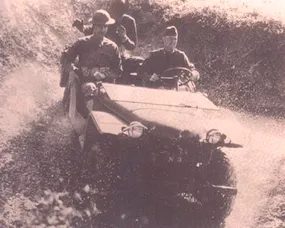
Wells was a Willys man, sure, but his 1946 book Hail to the Jeep captures the raw chaos of those early tests. After the initial 4,000-mile highway grind, the military threw the pilots into “cross-country” hell. They turned a field at the camp into a simulated war zone. Ditches. Hills. Rough ground.
The test rigs had light springs. They rode well enough that the drivers could push them harder than anyone else. They weren’t just driving; they were racing the limits of suspension travel. If the vehicle stayed intact, they went faster. If it bounced itself apart, they slowed down. The result? They averaged double the speed of competitors. It was brutal efficiency.
Then the sky opened up. Continuous rain turned the test field into a mud lake. Disaster struck for Willys. The oil bath air cleaner wasn’t mounted right. Mud and dirt sucked right into the engine through the intake. The engine got damaged. Badly.
They couldn’t afford a delay. So they did the unthinkable. They pulled an engine out of a Willys passenger car and stuffed it into the pilot model. It worked. The vehicle was back on course in hours. It wasn’t pretty, but it kept the timeline moving.
Ford Enters the Ring (Reluctantly)
Ford wasn’t interested. They were busy planning massive, heavy passenger cars with huge engines. The Army’s specs were tiny by comparison. But the Quartermaster Corps saw something Ford missed: capacity. The government needed Ford’s factories. Pressure mounted. Ford had to enter the contest.
Their entry was a stripped-down affair. They used their only available four-cylinder engine. It was a modified Fordson tractor unit. Essentially half of a Mercury V-8. It was a stopgap. Road & Track’s John Bond later tore into it. The valve guides split. There was no tappet adjustment. The pistons were semi-steel. The valve timing was non-existent. The combustion chamber design was an afterthought. It was crude.
Transmission issues plagued Ford too. They didn’t have a modern gearbox. So they slapped in the old Model A transmission. It was non-synchro. Rugged? Yes. Reliable? In a pinch, yes. But outclassed? Absolutely. It couldn’t handle the torque or speed the competition was achieving.
Differences Between Willys, Bantam, and Ford Early Jeeps
The divergence in engineering philosophy became stark here. Bantam started it. Willys refined it. Ford diluted it with tractor parts and legacy tech. Each company brought its own baggage to the table. The final Jeep wasn’t just a vehicle. It was a compromise born of necessity.
For more information on Jeeps, see:
-
History of Jeep
-
Consumer Guide New Jeep Prices and Reviews
-
Consumer Guide Used Jeep Prices and Reviews
The Late 1940 Compromise and the Weight War
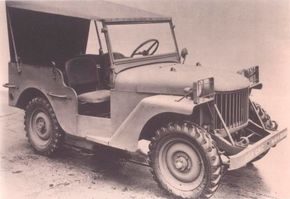
The dust hadn’t even settled from the initial evaluations of the Bantam, Ford, and Willys prototypes when the Quartermaster Corps (QMC) made a move that would define the early war effort. On November 14, 1940, they cut a deal. With the National Defense Advisory Commission helping to smooth over the cracks, the military ordered 1,500 units from each manufacturer. That’s 4,500 jeeps total. It was a political compromise. The General Staff wanted to bet the entire house on Bantam, the original creator. The Quartermaster General thought Bantam’s factory capacity was too small to be trusted and wanted to spread the risk. So, everyone got a slice.
But the testing phase had revealed that these weren’t just interchangeable boxes. The Army had specific likes and dislikes, and the differences between the three contenders were stark.
Breaking Down the Specs
The Army had already shifted goalposts once. They bumped the maximum weight limit from 1,300 pounds to 2,160 pounds to accommodate real-world needs. Here is how the three pilots stacked up against those hard constraints.
Weight
This was a major point of failure for one company. Both Bantam and Ford landed right on target. Bantam came in at 2,050 pounds. Ford sat at 2,150 pounds. Both were within the 2,160-pound limit. Willys? They clocked in at 2,450 pounds. That’s 290 pounds over the limit. To the Army, that was an unacceptable figure. It wasn’t just a number; it was a liability.
Fuel Efficiency
If you’re running a war, you care about mileage. Bantam took this round. Its 112-cubic-inch Continental engine produced 40 horsepower and sipped fuel more efficiently than its rivals.
Handling and Control
Braking distance and steering precision also went to Bantam. The little car turned and stopped better than the Ford or the Willys.
Driver Experience
Ford won the comfort category. If you wanted a ride that didn’t feel like a punishment, you got in the Ford. The pilot model had a broad, flat hood compared to the rounded shapes of Bantam and Willys. This wasn’t just aesthetic. The flat hood provided usable surface area for mounting equipment or sitting on, which mattered more than you’d think.
Raw Power
Here is where Willys fought back. They installed the “Go-Devil” engine. While Bantam and Ford had bumped their engine ratings from 40 to 45 horsepower, Willys was running a 61-horsepower unit. It was lightyears ahead in performance. The torque, the acceleration, the sheer muscle of that engine was undeniable.
The Final Push: 1941 Requirements
The order for 1,500 units from each company was set to begin deliveries in early 1941. But there was a catch. The manufacturers had to fix the deficiencies found during testing. They weren’t just rolling off the line as-is.
One major change was standardization on appearance. All three had to adopt the Ford hood and grille design. Why? Because the Army liked the flat look and the utility it offered.
Beyond cosmetics, the Army laid down specific performance mandates for these production models:
- Speed Limits: The vehicle had to hit a maximum of 55 mph on level ground. Crucially, the engine RPM couldn’t exceed the peak horsepower speed at that velocity. It also had to crawl. Minimum low-speed capability was capped at 3 mph.
- Water Fording: They needed to cross hard-bottom water crossings at least 18 inches deep without flooding.
- Traction: The construction had to allow for the installation and use of tire chains.
The Willys Problem
The designs were converging. They looked more alike. They performed more alike. But Willys was in a precarious position. The Army had made it clear: the 2,160-pound weight limit was official and final. No more extensions
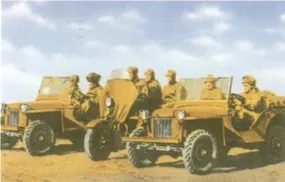
The deadlock didn’t break because of engineering brilliance. It broke because of paperwork. Or rather, the lack of it.
According to George Wells, the entire production standstill ended only because Under-Secretary of War Patterson decided to intervene. The military was ready to walk away. But Colonel H. J. Lawes, running the test center at Camp Holabird, dropped a hint. He told the Willys-Overland brass that the weight specifications weren’t set in stone. There was wiggle room.
Patterson took the hint. He gave Willys the green light to build their 1,500 test vehicles, officially waiving the strict weight limit.
The Weight of Freedom
You might think that’s a win. It wasn’t.
Ward Canaday, a key figure in the project, put it bluntly later. They had won the first round, sure. But the threat loomed large. If Willys couldn’t hit the 2,160-pound target, they’d lose every order after the initial 1,500. And if they stripped down their powerful engine and rugged chassis just to meet that lower number? They’d lose on performance anyway.
The military didn’t want a lightweight toy. They wanted a tank that could walk.
So Willys had a problem. A massive one.
They needed to shave 263 pounds off the vehicle. That’s 12 percent of the total mass. And they had to do it without sacrificing strength. Without sacrificing power.
How do you cut over a quarter of a ton from a vehicle that’s already built down to the studs?
Engineering Down to the Millimeter
Willys didn’t just tighten bolts. They rethought everything.
The original design by Bantam had been a rushed prototype. Ford had built on that, but added bulk. Willys had to be sharper. They looked at the frame. They looked at the body panels. They looked at every rivet.
One change stands out in the history of the Willys MB weight reduction strategy. The fenders.
The Bantam and Ford fenders were curved, heavy, and complex. Willys flattened them out. They used thinner steel. They changed the mounting points. It wasn’t just cosmetic. It was structural efficiency.
Then there was the engine bay. The Willys Go-Devil engine was compact, but the surrounding components were bloated. They trimmed the firewall. They simplified the brake system. They removed unnecessary brackets and reinforcements that hadn’t been stress-tested for actual combat conditions, just theoretical ones.
The result? A vehicle that was lighter than Bantam’s original prototype and significantly lighter than Ford’s submission.
Why It Mattered
This wasn’t just about passing a inspection. It was about survival.
By beating Ford and Bantam on weight while maintaining superior power, Willys proved that their design was the most efficient. The Willys MB vs Ford GPW comparison often focuses on engine specs, but the weight difference was the silent killer. Ford’s vehicles were heavier. Heavier meant more fuel. More wear on tires. Slower acceleration.
Willys had stripped the fat. They kept the muscle.
When the tests concluded
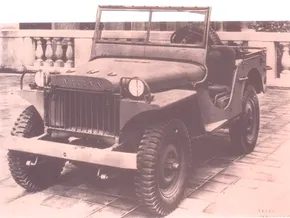
Slimming Down the Go-Devil
The Army’s weight limit was a hard ceiling, and it forced Barney Roos back into the Willys design well. By then, the Bantam and Ford contenders were already on the table. Roos knew he could shave nearly seventy-five pounds by swapping in a smaller engine. The Continental unit used in the Bantam pilot was the obvious candidate. But the military had a different priority. They liked the torque. They liked the power. So the idea of downsizing was shot down immediately.
Instead of changing the heart of the machine, Roos focused on its body. He was patient. Determined. Resourceful. He stripped the vehicle down to its skeleton. Every bolt. Every bracket. He looked for anything that could be cut.
How Willys Met the Weight Limit
The weight reduction strategy was granular. It wasn’t about major structural changes so much as eliminating excess. He shortened studs and screws. He even trimmed the cotter pins. Clamps, nuts, and washers were swapped for smaller, lighter versions. The heavy carbon steel frame was replaced by a lighter alloy.
Lighter steel also went into the body and fenders. The paint job became a strategic decision. One coat was enough. A second coat would have pushed the vehicle over the limit. The final weight met the specification exactly. Roos came in with just seven ounces to spare.
Tuning for the Battlefield
The weight cuts were only half the battle. Roos also tweaked the Go-Devil engine for real-world conditions. The carburetor and intake manifold were adjusted. The goal was better performance on steep grades. Mud, sand, and dust were constant threats in combat zones. Special air cleaners and oil filters were installed to cope with the dirt. These were minor changes. But they mattered.
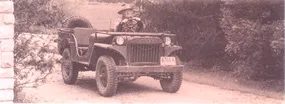
Barney Roos got all the headlines. Modern Industry magazine ran a story that seemed to completely ignore Probst and the Bantam people. The article claimed Roos went back to work with just an engine to build around while competitors struggled to keep their assembly lines intact. It was a clean sweep for Willys-Overland in the press.
But real-world testing told a different story. Once 4,500 jeeps rolled into service, the Army had plenty of time to compare the three makes. The preference was clear. The Willys won, mainly because its engine was more powerful. It wasn’t just horsepower. The Willys had skid plates under the motor and transmission. It used heavier gauge steel for the body. The front steering rods were durable two-piece tubular units.
The Bantam had issues. Critics called it buggy. It overheated. The transmission was too light for the job. Gears wore out quickly. Synchromesh was weak. The windshield wiper was hand-operated. The battery hanger was flimsy and needed constant welding.
Ford finished a distant third. One testing officer noted the Ford Pygmy had the most motor trouble. The engine was designed to work on a governor’s speed. There was considerable bearing trouble. The non-synchro transmission didn’t win any friends.
Yet the Bantam and Ford designs still had good bones. Those qualities ended up in the standardized jeep.
How the Jeep Standardized
The Army faced a problem. Three types existed. Each had virtues. The best solution was to build a new machine combining those features. Time and money dictated the second option. Take the best vehicle and graft on the good points of the others.
The Quartermaster Corps chose the graft. Incredibly, they elected to give Ford a negotiated contract for 16,000 units. Ford had placed dead last.
The Office of Production Management intervened. William S. Knudsen pushed back. Ford protested vigorously. The contract went to Willys-Overland instead. Willys had supplied the best test vehicle. They also underbid Ford by $640,000.
The QMC claimed Ford was a more dependable source of supply. Critics called Ford “the country’s foremost violator of the Wagner Act.” Six Labor Board decisions stood against them. Labor problems were real. Knudsen, an expert in production, was convinced Willys was competent.
A conference happened at the Holabird Quartermaster Depot. They discussed changes to the Willys unit. It was now designated the Model MA. The forthcoming Model MB received several modifications.
- An improved carburetor air cleaner was installed.
- A 40-ampere generator, known as the QMC Standard Generator, was used with a government-standard voltage regulator.
- A 15-gallon fuel tank replaced the 11-gallon tank of the Model MA.
- Larger five-inch sealed beam headlamps were adopted.
- A larger, government-standard battery was used.
- The handbrake moved from the driver’s left to the center console. The passenger could reach it in an emergency.
- The gearshift lever moved from the steering column to the floor. Uniform controls saved confusion when drivers switched vehicles.
- Steering tie rods were carried as high above the axle as possible to protect them from damage.
- Hydraulic brake hoses got protection.
- A double bow-top replaced the single-bow type. It increased head room without raising the silhouette.
- Spring shackles were sealed to keep out water and dirt.
- Provision was made to carry a shovel and an ax.
- Standardized blackout lights were adopted.
- A power take off was recommended. It operated special equipment for the Navy and Marine Corps.
The standardized MB jeep ended up two inches longer than the MA. It weighed 2,450 pounds. That was reasonable for such a stout vehicle. Experience led to further modifications.
Larger 6.00/16 tires and heavier combat wheels were added. Electrically, they specified a radio spark suppressor. An extra blackout driving light mounted on the left front fender appeared. A taillight connector socket was added for towing trailers. A five-gallon fuel can mounted at the back for emergencies.
What did the Army think of the final product?
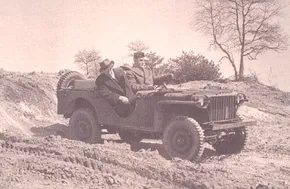
The Jeep as a Combat Multiplier
You think of the Jeep as a utility vehicle. You don’t think of it as a weapon. But by the time Major J. H. Chamberlain got in one, the military had already rewritten the rules of engagement. Chamberlain didn’t just test the limits; he watched them get obliterated. His verdict was blunt. The Jeep could fight just as hard as it ran.
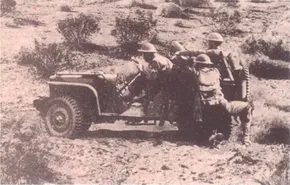
Consider the dispatch rider. A motorcycle is fast. It’s also a sitting duck. One sniper. That’s it. The rider drops. The orders are lost. The mission fails. The Jeep changes that equation entirely. You aren’t just carrying a courier. You are carrying armed men. Machine guns. Armor. It is a far tougher proposition on the battlefield.
But the real advantage wasn’t just firepower. It was geography. The Jeep could reach positions that other vehicles simply couldn’t. It climbed. It clawed. It ignored terrain that would stop a standard transport dead in its tracks.
Surviving the Abuse
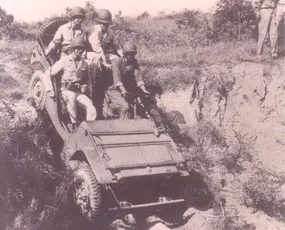
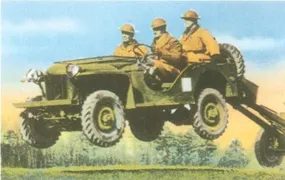
Chamberlain remembered a ride in Mississippi. Pine-studded acres. Speed at 50 miles per hour. He wasn’t expecting mercy from the driver. The Jeep hit a half-burned log. Hard. The front wheels tilted straight up to the sky.
Chamberlain’s internal monologue was simple: shattered crank case. Total loss.
He was wrong.
The Jeep had guard bars underneath. Built for this exact moment. The driver didn’t panic. He didn’t pop a wheelie. He grabbed special handles on the body. Lifted. Shoved. The Jeep slid off the log like it was nothing. No damage. No hesitation.
“Grueling tests showed that the jeep could fight as well as run.”
This wasn’t luck. It was engineering designed for abuse.
Low Profile, High Threat
Army strategists loved the silhouette. The Jeep stood only three and a third feet high. Low. Narrow. It looked like a jackrabbit in brush country. Hard to spot. Harder to aim at. If you couldn’t see it, you couldn’t hit it.
Then came the maneuverability test. The driver pointed the Jeep at a huge live oak. Branches gnarled and low. Chamberlain expected a swerve. A dodge. A display of handling.
No.
The driver kept the wheel straight.
“Duck!”
Chamberlain ducked.
The Jeep roared under the branch. The top of the car missed it by inches. Inside, Chamberlain realized something crucial. He weighed 190 pounds. He had stowed himself in the narrow space between the seat and the cowl. He had plenty of leg room. Plenty of arm room.
“Plenty o’ clearance,” the driver said.
It wasn’t tight. It wasn’t uncomfortable. It was efficient.
Wading and Climbing
They crossed a small stream. Water flowed over the floor. Chamberlain didn’t panic. He knew why. The electrical units were placed high up. The Jeep could wade through 18 inches of water without taking a sip.
Then the bank.
Thirty degrees. Steep. Twice as steep as any highway incline you’d ever face in a passenger car. The Jeep clawed its way up. No spinning tires. No sliding back. Just traction. Power. Forward motion.
This was the standard. This was the baseline. And it was just the beginning of what the vehicle could do.
The Jeep wasn’t just a military vehicle. It was a symbol of American ingenuity. Major Chamberlain saw it that way. Most Americans did too. It proved US industry could outthink and outproduce anyone.
Willys and Ford got the contracts. They kept the production lines running. Bantam was left behind.
The Willys MB vs. Ford GPW
The story gets interesting when you look at the specs. Willys had the MB. Ford had the GPW. Both were based on the original Bantam design. But neither was identical to the original.
Willys refined the chassis. They strengthened the frame. The wheelbase was slightly longer. Ford focused on simplifying manufacturing. They used more standardized parts.
This created a problem. Parts weren’t interchangeable between the two brands. A Willys fender didn’t fit a Ford. A Ford engine mount didn’t fit a Willys. Soldiers carrying extra parts had to know exactly which model they were repairing.
The differences were subtle. To a casual observer, they looked the same. Both had the iconic seven-slot grille. Both sat low to the ground. Both could go anywhere. But under the hood, the engineering differed.
Willys used a slightly different transmission housing. Ford’s engine had unique intake manifold patterns. These changes saved money. They also caused headaches for mechanics in the field.
Why Willys Won the Peace
When the war ended, the contracts shifted. Willys held the primary rights. They owned the trademark. They owned the design patents. Ford walked away.
This mattered. Willys kept the brand. They kept the momentum. Ford had no reason to stay. They had made their profit. They had built thousands of jeeps. But they didn’t want to compete in the civilian market.
Willys saw an opportunity. The war had proven the utility of the vehicle. Civilians could use it too. They needed a way to market it without infringing on military trademarks.
They chose the name “Jeep” carefully. It was already in the public consciousness. People called the military vehicles “jeeps”. Willys decided to adopt the nickname. They couldn’t use the military designation exactly. But the association was strong.
This move defined the future. Willys became the Jeep company. Ford never really entered the civilian off-road market with a direct competitor. They had the experience. They had the engineering talent. But they let Willys take the lead.
The result was a monopoly on a new market segment. Willys didn’t just sell a truck. They sold a lifestyle. They sold ruggedness. They sold independence.
The original Bantam BRC had started it all. But Bantam didn’t have the capital to survive the transition. They didn’t have the brand recognition. They were the spark. Willys became the fire.
The Cj-2A and the Civilian Era
Willys didn’t stop at the military model. They adapted it. The CJ-2A arrived in 1945. It was the first civilian Jeep.
It looked like the MB. But it had modifications. It had a wider track. It had a different axle housing. It had a civilian engine tune.
The price was high. The war had ended. Supply chains were shifting. But people bought them. Farmers bought them. Ranchers
How Ford Built the GPW Jeep Without Bantam
By October 1941, the Army realized its mistake. They had underestimated the jeep’s versatility and usefulness by miles. The single-source supply chain was a liability. If the Willys plant in Toledo got bombed or sabotaged, the war machine stalled. The military needed redundancy. They needed a second source.
Enter Ford.
Quartermaster General E. B. Gregory didn’t bother asking Bantam again. He went straight to Edsel Ford. The request was unprecedented. Ford was to build the Willys MB design but use the Barney Roos “Go-Devil” engine. That’s the key. Interchangeability wasn’t just preferred; it was mandated. Every bolt. Every nut. If a Willys part broke, a Ford part had to fit.
Edsel Ford said yes. No hesitation. No boardroom debate visible to the public. On January 10, 1942, the deal was public.
Ford would produce 15,000 GPW (General Purpose Willys) vehicles. The contract price? $14,623,900. That’s nearly a billion in today’s money, adjusted for inflation, but back then, it was just a line item in a wartime budget.
Willys handed over everything. Patents. Specifications. Blueprints. Some accounts say they took no compensation for the IP transfer. Others claim a royalty was paid. The records are muddy. What isn’t muddy is the fact that this was likely illegal. Antitrust laws weren’t designed to let two direct competitors share proprietary manufacturing secrets under government duress. But the war effort didn’t care about antitrust. They cared about wheels on the ground.
Identifying the Ford GPW vs Willys MB is actually quite easy for anyone who knows what to look for. The front frame cross member is the giveaway. The Ford GPW features an inverted U-shaped cross member. It’s sturdy. Industrial. Look at a Willys MB, and you’ll see a tubular brace instead. That’s the visual tell. It’s a subtle difference, but in the field, that distinction meant nothing until you were trying to source parts.
Meanwhile, at Bantam, the mood was toxic. Frank Fenn, the president, was livid. He had built the first prototype. He had done the heavy lifting in development. And he was being cut out.
In a letter dated March 23, 1942, Fenn wrote to historians (via Denfield and Fry) that he couldn’t comprehend how Bantam was denied a bid. They had performed the major part in the jeep’s development. Yet, there they were, watching Ford and Willys split the pot while the founders watched from the sidelines.
Why did Willys take the lead? Probably because they had the capacity. Why did Ford join? Because Edsel Ford knew that if the government wanted two suppliers, they’d pick the ones who could scale fastest. Bantam couldn’t scale. Willys and Ford could.
The result was a hybrid army. Half the jeeps rolled out of Toledo. Half came from Dearborn. And the Bantam team? They got to keep their engineering talent, even if they lost the production contract. The jeep
The Bantam Betrayal and the Birth of an Icon
Roy Fenn didn’t mince words. He argued that his team had pioneered the concept of a standardized vehicle by cherry-picking the best features from the three competing prototypes. He expected a cut of the profits from the mass-produced machine that would eventually define the war effort. He had already fronted over $130,000 in tooling costs for axle production to Spicer. That wasn’t just a business expense. It was an informal subsidy for Ford and Willys, props they needed to get their own lines rolling.
Yet, the checks never arrived.
American Bantam received no further Jeep contracts. The reality of industrial scale crushed their initial momentum. By the time the ceasefire sounded, Willys had rolled out 362,841 quarter-tonners. Ford had built 281,448 more. Bantam, the originator, had been limited to the first 2,643 units. A drop in the bucket.
There was one last card to play. The four-wheel-steer prototype. Eight pilot models had been submitted. The using arms pleaded for the feature. The Quartermaster Corps shut it down. They cited complexity. Field maintenance nightmares outweighed the tactical advantages. It was a pragmatic, if brutal, decision.
Looking back, the shift to Willys and Ford wasn’t entirely irrational. Bantam’s financials were shaky. Their factory capacity was tiny. The bigger players had the infrastructure to mass-produce a reliable machine. The result was one of WWII’s most enduring legends. But for Bantam, it was just the end of the road.
For more information on Jeeps, see:
-
History of Jeep
-
Consumer Guide New Jeep Prices and Reviews
-
Consumer Guide Used Jeep Prices and Reviews