
Governments want tax revenue. Drivers want cheap miles. The result? A frantic scramble to find an energy source that isn’t gasoline. For years, the industry swung between hype and hollow promises. Hydrogen? Still waiting on the infrastructure. Battery density? Improving, but slow. The latest contender, however, isn’t a new element or a complex chemical compound. It’s the very thing we’re trying to eliminate. Carbon dioxide.
Can we actually turn exhaust into energy?
It sounds like sci-fi alchemy. Take the greenhouse gas that’s warming the planet, strip it apart, and rebuild it into liquid fuel. Several companies are currently racing to make CO2 fuel a commercial reality. They aren’t just talking about it anymore. They’re building pilots. The logic is seductive. If you can capture the carbon emitted by one engine and convert it into fuel for another, you create a closed loop. A circular carbon economy, essentially. No new fossil fuels need to be drilled. Just recycled.
But the devil is in the chemistry. And the economics.
The energy cost of turning air into fuel
The process generally involves capturing CO2 from industrial emissions or even directly from the atmosphere. Then, you need hydrogen. Not just any hydrogen, but green hydrogen—produced via electrolysis using renewable electricity. You smash the CO2 and H2 together under high pressure and heat, using specialized catalysts. The result? Synthetic fuels, often called e-fuels or power-to-liquid (PtL).
The catch? It takes a massive amount of energy to make it happen. Electrolysis is inefficient. Compression is energy-intensive. The conversion process loses a significant chunk of that original renewable power. So, while the fuel is carbon-neutral when burned, the production chain is far from it. Unless you have an absurd amount of surplus wind or solar power, the math gets ugly fast.
Why the sudden interest?
Why now? Because the internal combustion engine isn’t going away quietly. The EU’s 2035 ban on new ICE cars has sparked panic among legacy manufacturers. Porsche is already investing heavily in e-fuels. They argue that while new cars must be electric, the billions of existing ICE vehicles on the road need a drop-in replacement for gasoline. Diesel, jet fuel, marine fuel—they all need alternatives. CO2-derived fuels offer a bridge. A way to keep the engines running without adding new carbon to the atmosphere.
But is it cheaper? Not yet. Production costs are high. The infrastructure for distributing these synthetic fuels doesn’t exist at scale. And the efficiency gap remains a glaring problem. An electric motor is roughly 77-90% efficient from grid to wheel. An e-fuel engine? Maybe 30-40%. You’re throwing away half your energy just to burn it.
The real question isn’t if it works, but if it matters
The technology works. We’ve known this for decades. The Haber-Bosch process did something similar with ammonia in the 20th century. The Fischer-Tropsch process converts coal to liquid fuel, used heavily in South Africa. Now, we’re just swapping coal for captured CO2 and green hydrogen.
The bottleneck isn’t science. It’s scale. Can we produce enough green hydrogen
The Economic Reality of Carbon Fuel
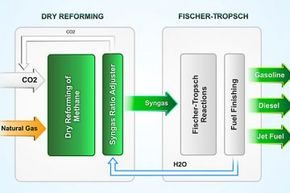
Byron Elton isn’t just selling a dream. He’s pointing to a concrete $10 billion joint venture between Louisiana and Sasol, a South African energy giant, to build a massive Gas-to-Liquid (GTL) plant near Lake Charles. The goal? To prove that CO2-fueled vehicles aren’t just a lab curiosity. They’re coming. Fast.
Elton’s company, Carbon Sciences, has a process that turns CO2, methane, and a catalyst into syngas. This syngas becomes clean diesel. Later, jet fuel. Then gasoline. No engine swaps. No retrofitting. Just pump it and go.
The Fischer-Tropsch process behind this isn’t new. It fueled tanks in WWII. But it was always too expensive to compete with crude oil. Elton claims that’s changed. His technology allegedly makes it viable. And clean. He argues we’re not just making fuel. We’re scrubbing the atmosphere.
But not everyone is buying it.
The opposition doesn’t deny the chemistry. They deny the economics. Making fuel from CO2 is costly. It’s inefficient. The energy input required to capture and convert the carbon often outweighs the energy output of the final drop.
So what do we get? A cleaner burn. A smaller footprint. But at a higher price. And a lower efficiency.
Are we really solving the climate problem? Or just finding a more expensive way to drive?
Trading Bad for Less Bad
The debate isn’t about physics. It’s about pragmatism.
If you’re a policy maker looking to meet aggressive emissions targets, CO2-fueled vehicles offer a direct path. You capture the waste. You turn it into energy. You loop it. It’s circular. It’s sexy.
But if you’re an engineer or a consumer, the math gets ugly. The LCA (Life Cycle Assessment) tells a different story. The infrastructure for GTL is capital intensive. The energy density is good, but not enough to offset the extraction costs.
Some argue we’re trading the bad air of petroleum for the bad economics of synthetic fuel. It’s a net gain in purity. A net loss in affordability.
Elton says the cost will drop. Sasol says the volume will justify the price. The Louisiana state government says the jobs justify the risk.
But the skeptics remain. They see a solution looking for a problem. Or a problem that’s already being solved by batteries and renewables.
Why invest billions in a complex chemical plant when you could just electrify the grid?
The answer depends on what you value more. Immediate reduction in tailpipe emissions? Or long-term systemic efficiency?
There’s no easy answer. Just a choice between two imperfect futures. One burns dirt. The other burns money. Both burn carbon.
The fuel is ready. The question is whether anyone will pay for it.
The Thermodynamics of Carbon Recycling
The hype around capturing CO2 to create synthetic fuels sounds eerily familiar to Ozzie Zehner. A visiting professor at UC-Berkeley and author of the forthcoming book Green Illusions (Bison Books, 2012), Zehner sees a direct parallel to the hydrogen fuel cell boom that fizzled out just a few years ago. That era promised a clean future powered by excess solar energy used to split water into hydrogen. The catch? The energy accounting never added up. You had to pump more power into the electrolysis process than you ever got back from the fuel cell.
It’s like running a money-printing machine that costs $23 to print a $20 bill. You are literally spending value to create value, with a net loss.
Zehner argues that creating synthetic fuels from carbon dioxide is just as energetically punitive. Proponents claim these processes can store heat or electricity in a dispatchable liquid form for later use. That’s technically true. But here is the hard truth Zehner emphasizes: CO2 is not a fuel. It is a waste product. It must be chemically refined into something combustible, like methane, which is the primary component of natural gas.
The barrier is thermodynamics. Specifically, the endothermic reaction required to bond carbon and hydrogen. You have to inject significant heat and energy to drive the reaction. You might get some fuel out, but you will never get all that input energy back.
“Until they figure out how to change the laws of thermodynamics,” Zehner says, “we are stuck with what we have.”
So why go through the complex, energy-intensive rigmarole? Zehner points out that it is far easier and cheaper to simply extract existing natural gas resources. We already have massive reserves of methane in the ground. Why pay to strip CO2 from the atmosphere, mix it with hydrogen, apply intense heat, and then extract the resulting methane? No industrial player does that. The economics don’t work when you have a ready supply of the finished product.
Then there is the cleanliness argument. Advocates suggest synthetic fuels are cleaner than fossil fuels. By definition, they aren’t. You need energy to create or reform the fuel. If that energy comes from nuclear power to get enough volume for the conversion process, you are left with a political question: Is nuclear actually cleaner than digging up fossil fuels? The answer depends on who you ask.
Why Carbon-to-Fuel Sucks Energy
The core issue with synthetic fuels is the energy penalty. To turn CO2 into a usable fuel like methane, you need an endothermic reaction. This means you must supply external heat and energy to drive the chemical change. You get some energy back in the resulting fuel, but never all of it. As Zehner notes, until someone figures out how to change the laws of thermodynamics, we are stuck with the physical reality of energy loss.
Zehner compares this to the failed hydrogen dream. Hydrogen fuel cells were supposed to use excess solar wind power to create hydrogen. The problem? It took more energy to create the hydrogen than you got out of it. It’s like having a machine that creates $20 bills, but it costs $23 to create each one.
Zehner argues that creating CO2 fuels is just as energy intensive
The False Equivalence of Green Car Advocacy
Zehner’s conclusion lands with a heavy thud. He argues that we are simply swapping one problem for another. “It isn’t acceptable for doctors to promote low-tar cigarettes,” he notes. “Why should environmentalists promote alternatively fueled automobiles?”
It sounds sharp. It plays well in a debate. But does it hold up when you look at the actual mechanics of the situation? The low-tar cigarette analogy ignores the fundamental difference between a product that is inherently toxic and a technology that is simply less harmful than its predecessor.
The lingering question isn’t just rhetorical. It is practical. Is a “lower tar” alternative a viable solution for the environment? Or are we just polishing the chrome on a sinking ship? The debate over whether alternative fuels are a genuine fix or a marketing distraction remains wide open.