You probably think your hitch setup is bulletproof. The ball is in the coupler. The pin is locked. The safety chains are crossed and clipped. It feels secure.
But physics doesn’t care about your confidence.
If you’re the type who always hits green lights and finds parking spots effortlessly, you might skip the redundancy. Optimism is nice. Preparation is mandatory. When you’re hauling tons of metal and fiberglass down a highway at 70 mph, optimism is a liability.
That’s where towing safety cables come in. Or chains. The terms are often used interchangeably, but the principle is identical: backup.
Most tow vehicle owners know the basics. You’ve got a receiver hitch on the frame. A ball mount slides in. A locking pin keeps it from wiggling out. The ball on top fits the trailer coupler. This is the primary connection. It’s designed to carry the load. It’s designed to steer.
It is not designed to hold the trailer to the truck if it fails catastrophically.
And it will fail. Sometimes. Not often. But often enough that federal law demands a secondary tether.
The Law Doesn’t Care About Your Good Luck
Why do you need them? Because gravity and inertia are unforgiving.
If the coupler pops off the ball—due to vibration, wear, or a simple manufacturing defect—the trailer detaches. That’s not a minor inconvenience. That’s a projectile.
A 5,000-pound travel trailer doesn’t just stop. It keeps moving. It might jackknife. It might spin. It might end up in the oncoming lane. Or worse, it might end up on your roof.
Federal regulations in most states mandate towing safety cables for a reason. They aren’t optional accessories. They’re legal requirements. If you’re caught without them, you’re not just risking your life. You’re risking a ticket. And insurance denial.
The primary hitch carries the weight. The secondary safety system catches the trailer if the primary fails. Simple.
How Towing Chains and Cables Prevent Disaster
You might be wondering, which is better? Chains or cables?
It’s not a binary choice. Both serve the same function. The difference is in the material and the feel.
Towing chains are traditional. Heavy gauge steel links. Durable. They can handle abuse. They’re cheap. But they’re heavy. And they can kink. If not managed properly, they can drag on the pavement and wear down fast.
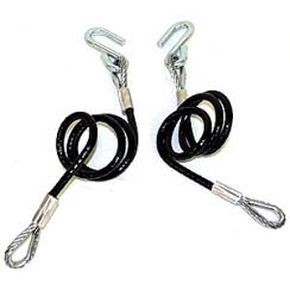
Towing safety cables are newer. Braided steel wire inside a protective jacket. They’re lighter. They don’t kink. They’re easier to handle. But they’re more expensive. And if the jacket gets cut, the cable can fray.
Most experts recommend crossing them. X-pattern. This creates a cradle under the tongue. If the coupler fails, the trailer drops into the X. It doesn’t swing wildly side-to-side. It stays relatively centered.
This isn’t just theory. It’s engineering.
Crossed chains or cables create a cradle effect, stabilizing the trailer tongue if the hitch connection fails.
Without this cross, the trailer tongue can whip around. It can strike the side of the tow vehicle. It
Choosing Between Safety Cables and Heavy-Duty Chains
It honestly comes down to preference whether you grab a set of towing safety cables or stick with traditional chains. As long as you’re consistent and actually know how to use them, the material doesn’t change the outcome. People use the terms interchangeably sometimes, but the distinction is basic: cables are durable metal wire strands, while chains are heavy-duty interlocking links.
The job is the same for both. If that trailer hitch fails or the coupler pops off, these aren’t just accessories—they are the backup plan. By crossing them under the trailer tongue and hooking them to the frame of the tow vehicle, you create a net. This prevents the dead weight from sliding off the road and spinning into your lane. They won’t pull the trailer for miles, but they will stop it from hitting the pavement instantly. That gives you seconds. Seconds to grab the wheel, slow down, and pull over before everything goes sideways.
Sizing Your Towing Safety Cables for Gross Trailer Weight
You can’t just buy the first set of hooks you see. The weight class matters. If you pick gear rated for less than what you’re hauling, you’re not towing. You’re playing Russian roulette with your transmission and the asphalt.
Match the capacity to your gross trailer weight (GTW ). That’s the total mass of the loaded trailer. Your safety cables need a higher rating than the hitch itself. The industry breaks these down by class:
- Class I: Handles up to 2,000 lbs (907 kg) GTW.
- Class V: Rated for up to 10,000 lbs (4,536 kg) GTW.
If you’re pulling a 5,000-pound boat, a Class II loop is useless. It will snap. Check the rating on the hardware. If your tow vehicle or trailer frame lacks a dedicated attachment point, you need to weld a safety chain loop or bracket. Make sure the weld can handle the load. A weak mount is just as bad as weak cables.
Securing the Hook: S-Hooks, Slip Hooks, and Quick Links
How you attach the cable to the frame is where people get sloppy. S-hooks are the standard. They curve like the letter ‘S’ and hook onto the frame. But they have a fatal flaw: vibration. On a bumpy highway, an S-hook can bounce out. If you use them, you need rubber keepers to lock them in place.
Slip hooks and quick links are better. They close shut and stay closed. No bouncing. No accidental release. If you want to sleep at night, use the positive locking hardware. Just double-check that the connection is tight. A loose hook is just dead weight dragging behind you.
Adjusting Slack: The Goldilocks Zone
Once the cables are on, check the tension. This is where most errors happen.
Too tight? You’ll bind the steering. You won’t be able to make a full turn without the cables pulling the trailer tongue sideways. That causes jackknifing.
Too loose? The cables will slap the road. They’ll drag. Eventually, they’ll snap or detach from the debris. You need enough slack for articulation but not so much that they touch the pavement. Just right. Not too tight. Not too loose. If they’re dragging, they’re doing nothing for you when disaster strikes.
Why Towing Safety Cables and Chains Are Non-Negotiable
You might think you’re a good driver. You might think you’ll never lose a load. But towing isn’t about your skill. It’s about the equipment failing. Ball joints break. Hitches shear. Gravity always wins eventually.
These cables and chains are the last line of defense. Whether your state mandates them or not, you should be using them. They don’t cost much. They don’t add much weight. But they might save your life.
Towing is not an area where you want to be on the losing end.
Drop the toast butter side down once in a while. It happens. But don’t drop the trailer.