


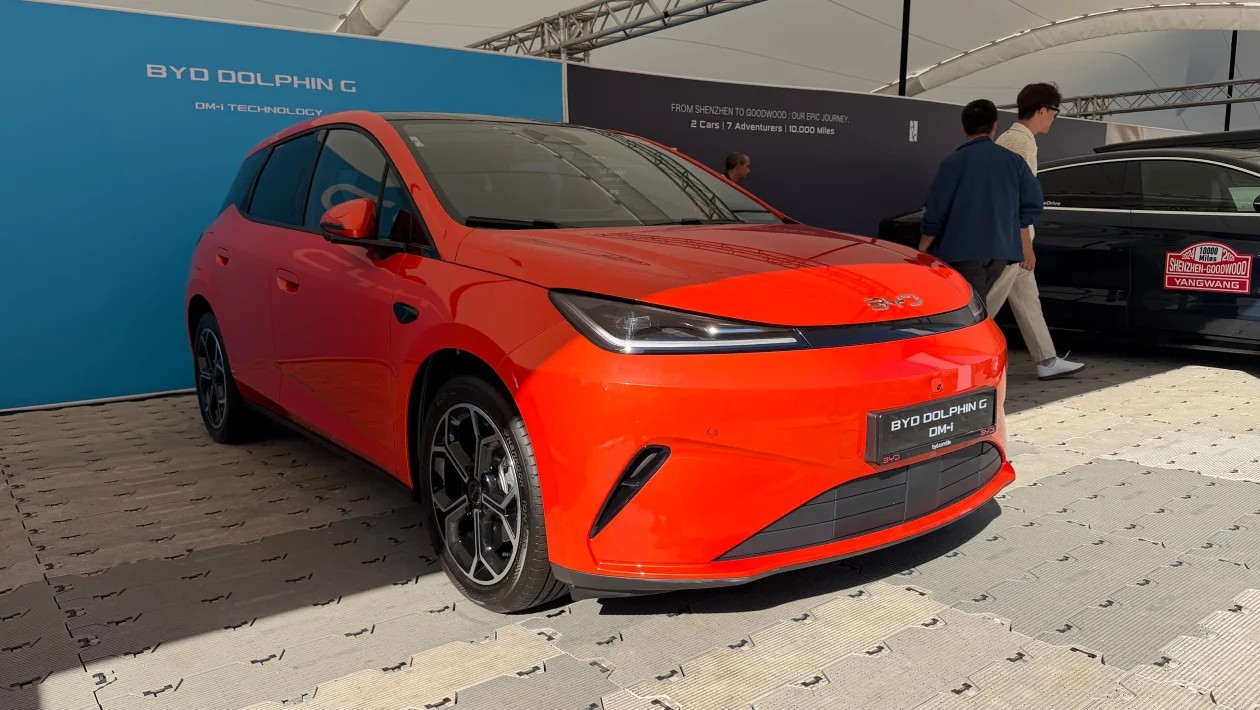
It’s here. The BYD Dolphin G.
And it’s cheap. Startingly cheap. At under £24,000 it’s the UK’s cheapest plug-in period. End of sentence.
We saw it at the 2025 Goodwood Festival of Speed. It comes in four flavors. Active is £23,999. Boost is £26,999. Then there’s Comfort at £28,499 and the sporty top-end Sport at £29,499. The lower trims have small batteries. The higher ones get the big ones. Even the priciest Sport undercuts the cheapest rival plug-in hybrid—the Geely Staray EM-i—by £500.
You can order one now. Deliveries start in September.
This isn’t just another import slapped with a label. This is BYD’s first model designed in Europe, for Europe. They are going after the “B-segment”. The big leagues. Think Renault Clio. Toyota Yaris.
But here is the kicker. None of those rivals are plug-in hybrids. They’re full hybrids. Or nothing.
What’s under the bonnet
Forget the electric Dolphin we already have. This is different. The Dolphin G uses BYD’s “Super Hybrid” DM-i system. It’s the same setup found in the Atto 3 DM-i and Seal U.
One petrol engine. 1.5-litres. Two electric motors. One drives the wheels. The other charges the battery. Simple enough? Maybe.
The Active trim gets a puny 7.4kWh battery. BYD claims 25 miles of electric range. If you want real range you pay for Boost, Comfort or Sport. They get an 18.3kwh pack. That gives you 65 miles on electricity.
The system favors electric driving. It’s quiet. Smooth. The petrol engine steps in when you floor it or need more power. BYD says you can drive up to 640 miles on a full tank and battery. That feels optimistic. It always is.
Performance isn’t the headline act but it’s respectable. The base model makes 173 horsepower. The others make 209. All of them hit 62 mph in 8.3 seconds. Top speed is 112 mph. It’s fast enough for the M4. Charging? A home wall box does 7kW. DC rapid charging hits 39kW on the bigger batteries. That gets you from 10% to 80% in 26 minutes. Not instant. But fast.
Size matters
The Dolphin G is long. 4.16 meters long to be exact. That makes it slightly bigger than a Skoda Fabia or MG3. The wheelbase is 2.6 meters.
Inside? Roomy. They say it seats five adults comfortably. The boot holds 425 litres. That is bigger than a VW Golf’s. There’s even a 45-litre false floor compartment. Fold the rear seats flat (40:60 split) and you’ve got 1.225 cubic meters. It’s surprisingly practical.
Kit levels
The base Active gets you the basics. A 10.1-inch screen. A smaller 8.8-inch digital cluster. Apple CarPlay. Android Auto. Cloth seats. Blind spot detection. Adaptive cruise control. You won’t feel left behind.
Boost adds tinted windows. Heated seats. A vegan leather wheel. It throws in extra air vents for some reason. It upgrades the screen to 12.8 inches. Adds ambient lighting.
Comfort adds Google integration. Maps. Assistant. 18-inch wheels. Mixed materials in the seats. A 360-degree camera.
Then there’s Sport. Everything else. Sharper look. Suede panels. Black or orange and blue accents. Two exclusive paint colors. It looks distinct. Maybe too distinct for some tastes? Who knows.
Designed for narrow streets
BYD knows what’s missing. Stella Li, the executive VP, said they are missing volume in the B-segment. They missed the boat before. Now they’re jumping on board.
Pre-G BYD cars were designed for China. Big cars. Wide chassis. They don’t fit Paris. They don’t fit London. Or Rome.
Li admitted the divergence. Chinese markets want bigness. Europe wants smallness. The competition is forcing hands everywhere else to go big and it has become “crazy”. So BYD is changing course.
They are splitting product development. Cars under 4.3 meters will be optimized for Europe. A factory is coming to Hungary. An R&D center in Budapest. They want local designs for local tastes. It mirrors Kia’s strategy back in the day with the Ceed. It worked then.
The Chinese giants are coming. Hard. Legacy makers should worry. Market share doesn’t grow on its own.
Is this enough to convince the Clio buyers to switch? That is the question.


