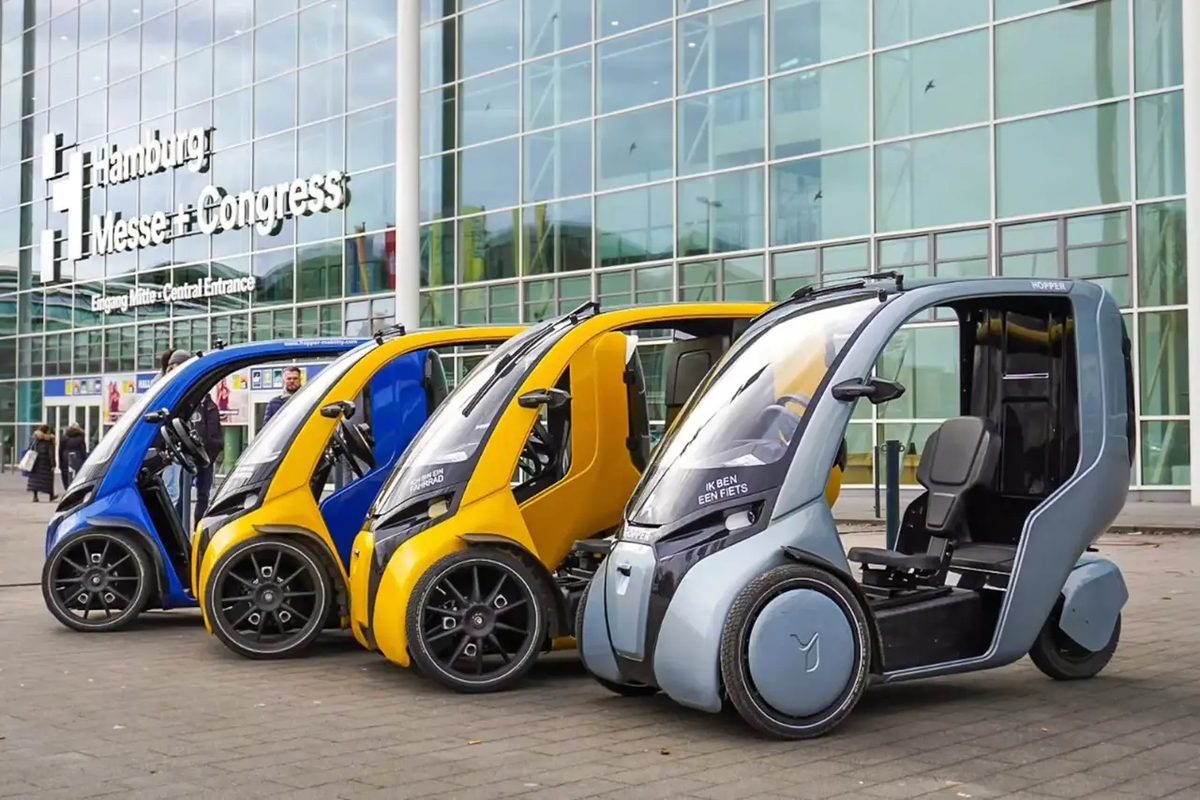
It’s easy to look at the Hopper and squint until you see the ghost of the BMW C1 scooter from the early 2000s. Or maybe the Renault Twizy. The Veemo too. It’s that familiar silhouette of a tiny enclosed vehicle. But the Hopper, designed by German firm Hopper Mobility, is an oddity. It has a three-wheel configuration with open sides. It mimics the comfort and driving position of a car. It’s a surprise. It is actually an electric bicycle.
This distinction matters. Because it’s an e-bike, it doesn’t just share the road with traffic. It can use bike lanes too. The engine sits in the rear hub. It pushes out 250 watts. Regulation caps the assisted speed at 25 km/h. Power comes from a removable 1,440 Wh battery. The manufacturer claims an autonomy of 65 kilometers. You can stretch that range slightly with an optional photovoltaic panel on the roof.
How the Hopper Works Differently
There’s no chain. Instead of mechanical transmission, pedaling drives a generator. This converts your mechanical effort into electricity for the motor. It’s a unique setup.
At the front, two 20-inch wheels provide stability. A 10-inch scooter-style wheel sits at the rear. There is no handlebar. You steer with a wheel. A digital dashboard sits ahead, much like a microcar. The vehicle includes a windshield defroster. A proper parking brake is included. Two traffic lights are mounted at the front.
The Hopper is a true outlier on the road. It looks like a car, but legally and mechanically, it is an electric bicycle.
Commercial Availability and Specs
Hopper Mobility is planning a commercial rollout. They want to offer a passenger version. A cargo variant is also on the table. Both could carry a payload of 160 kilos, users included. Right now, only a few units are in circulation for testing. The brand plans to sell the Hopper first in Germany. Pre-orders are open. The price is set at 13,500 euros.
Why the high price tag for a bike? You get a steering wheel. A dashboard. Defogging. It’s not just a frame and wires. It’s a fully enclosed cockpit on three wheels. It’s a car-lite for urban commutes.
Who is this for? Someone who wants weather protection without the car insurance costs. Someone who wants to bypass traffic jams in bike lanes. It’s a specific niche. A weird one.
The pre-orders are live. The testing phase is ongoing. The rest of the world watches. Will the 13,500 euro price point hold up? Or will it remain a curiosity for early adopters? The answer lies in how many people actually want to pedal a steering wheel to work.